Review: Vumbura Plains
Kwedi Concession (NG22), Okavango Delta, BotswanaTwo nights • August 4–6, 2026A Sundowner Safaris Camp ReviewAt a glance
- Location
- Kwedi Concession (NG22), Okavango Delta, Botswana
- Operator
- Wilderness
- Type and size
- Premier-tier water camp, split into North and South; North has six twin/double suites and two family suites
- We stayed
- 2 nights, August 4–6, 2026 (three suites at North, each set up as a double)
- Our rating
- 4.6 / 5 · Room 4.3 · Service 4.5 · Food 4.7 · Guiding 5.0 · Location 5.0
- Best for
- Guests wanting the Delta's permanent water plus land driving, birders, photographers who bring their own support gear, and families
- Not ideal for
- Guests wanting a small, intimate camp (Little Vumbura suits better); non-couples sharing a suite; daily workers needing connectivity
- Getting there
- Wilderness Air flight to the Vumbura airstrip, then a 25–30 minute boat transfer to camp
Vumbura Plains is Wilderness's premier-tier water camp on the northern edge of the Okavango Delta, and this review is written against that standard — premier pricing, premier expectations, no allowances made.
We came in from Chitabe for two nights, as the water half of a Botswana pairing: Chitabe for dry-land predators, Vumbura for permanent water. Traveling were myself, my father-in-law Mo, and Benson Siyawareva — my business partner and Sundowner's Managing Director for African Operations and Private Guiding. Benson has guided in Africa since 1988, holds full licenses in both Zimbabwe and Botswana, and ran Wilderness camps himself — Little Makalolo in Hwange, Savuti in the Linyanti — before spending a decade running his own operation; Condé Nast Traveler named him one of the best safari guides in Africa. He visits these camps often enough that his reputation arrives before he does, and having him in the vehicle changes what a review like this can see.
I should declare an interest before going further. Little Vumbura, on this same land, was the first safari camp Samar and I ever stayed in — our honeymoon, booked for 2020 and finally taken in 2021. This concession is where our safari life began. Coming back five years and a great many camps later is its own kind of test: the ground that set our baseline, now measured against everything we have seen since.
The short version: the concession is as good as water country gets in the Delta, the guiding was among the best we have experienced anywhere, and the camp itself did not move us the way we expected it to. Vumbura is a property whose land is stronger than its rooms.
Getting There
We left Chitabe around ten in the morning and game drove to the airstrip rather than transferring straight to it. The Wilderness Air flight came in on time at about 10:55, and we were on the ground at the Vumbura airstrip by 11:15.
Tsono, who would guide us for the whole stay, met us at the strip and drove us to the boat dock. From there it is roughly twenty-five to thirty minutes into camp by boat, and in a flood year that transfer is not a logistical inconvenience — it is the first activity of the trip. You arrive having already been on the water, through channels with lechwe on either side, which sets the tone far better than a road transfer ever could.
Tumelo, who would host us for the whole stay, met the boat at the jetty with welcome drinks. Paperwork and the camp briefing were handled quickly before we sat down to lunch, and the rooms were ready about an hour later. He was on that jetty, or somewhere close to it, more or less every time we came back in over the next two days.
Going out is equally easy. Benson flew at 08:30 on our final morning; Mo and I followed later, with one stop at Chitabe to pick up other guests before Maun. Worth knowing for anyone routing through: the Wilderness lounge at Maun airport is new and genuinely pleasant, which is not a sentence one often writes about an airport lounge in a small town. It made the connection to Johannesburg painless.
Setting & Location
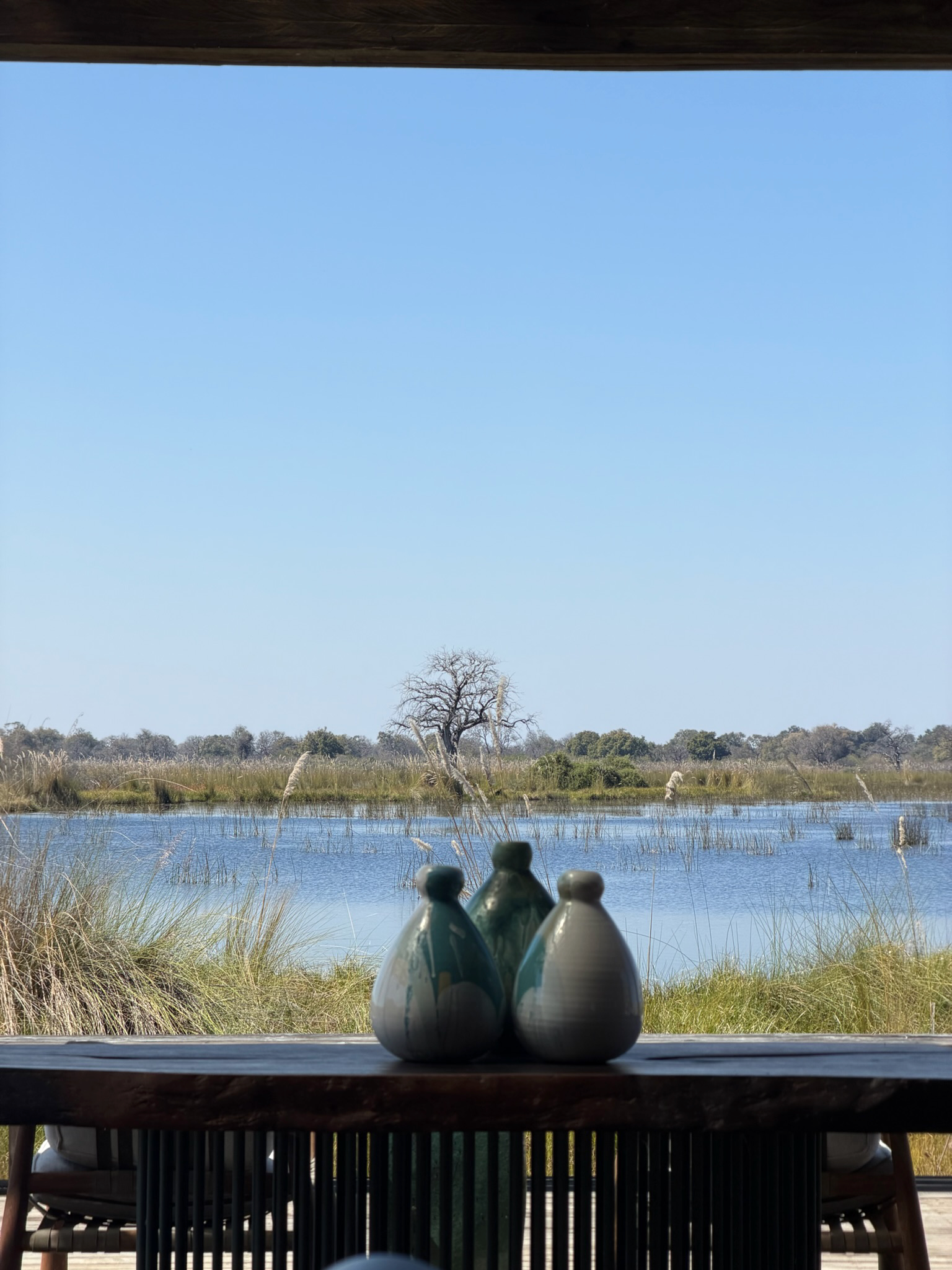
Vumbura sits on the Kwedi concession (NG22), on the northern edge of the Okavango Delta, bordering Moremi Game Reserve to the south, with roughly 60,000 hectares of exclusive traversing.
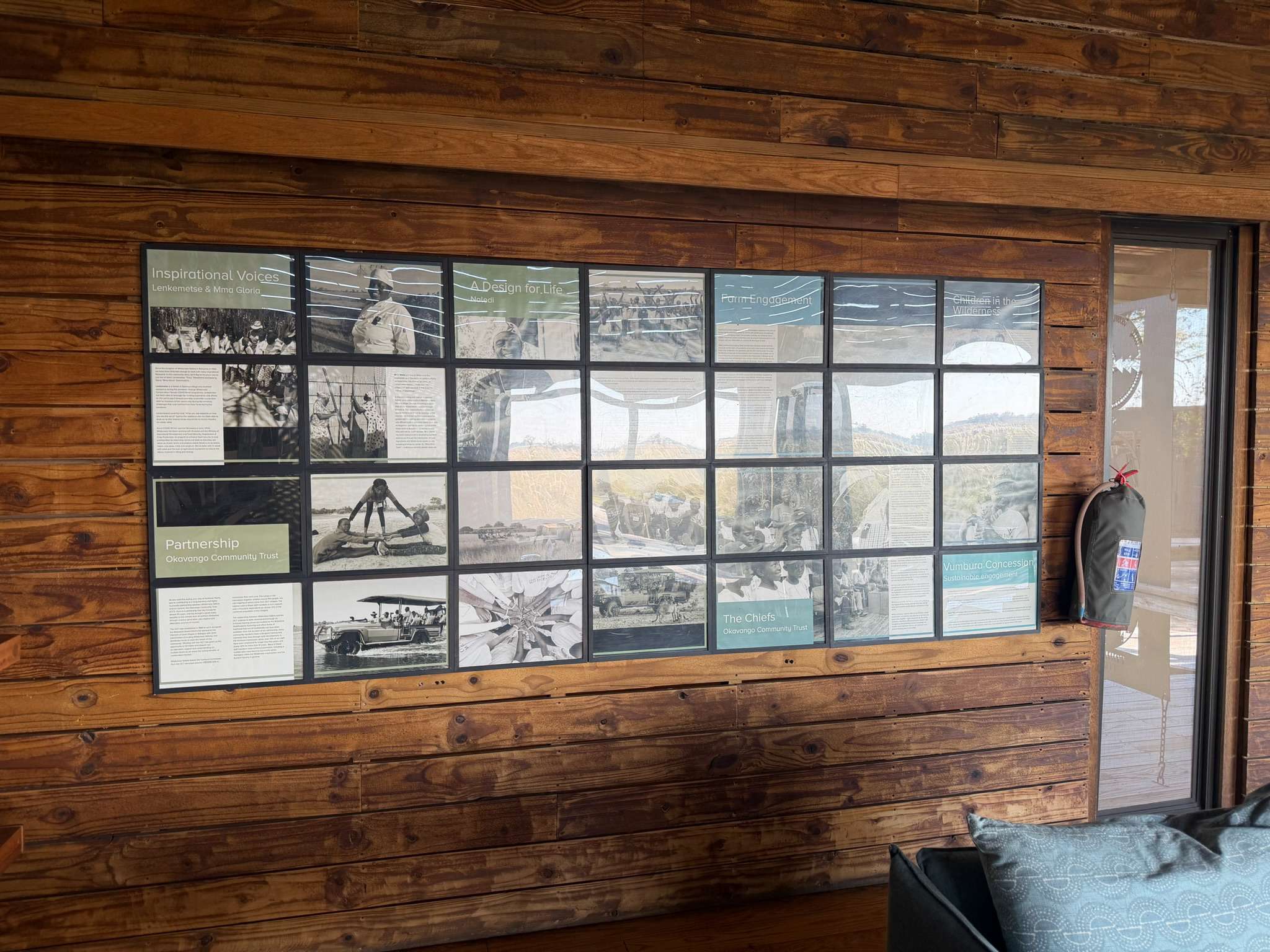
The land is not leased in the usual way, and the difference is worth understanding. The head lease is held by the Okavango Community Trust, formed in 1996 on behalf of five local villages, with Wilderness operating the camps under sublease and paying annual fees back to the Trust. What makes that arrangement matter to a guest is that those villages are represented on the team. A large share of the staff comes from the surrounding communities, and it gives the camp an authenticity that a concession staffed from elsewhere cannot buy. It is most visible at the craft market on afternoon tea days, where the work is sold directly by the person who made it.
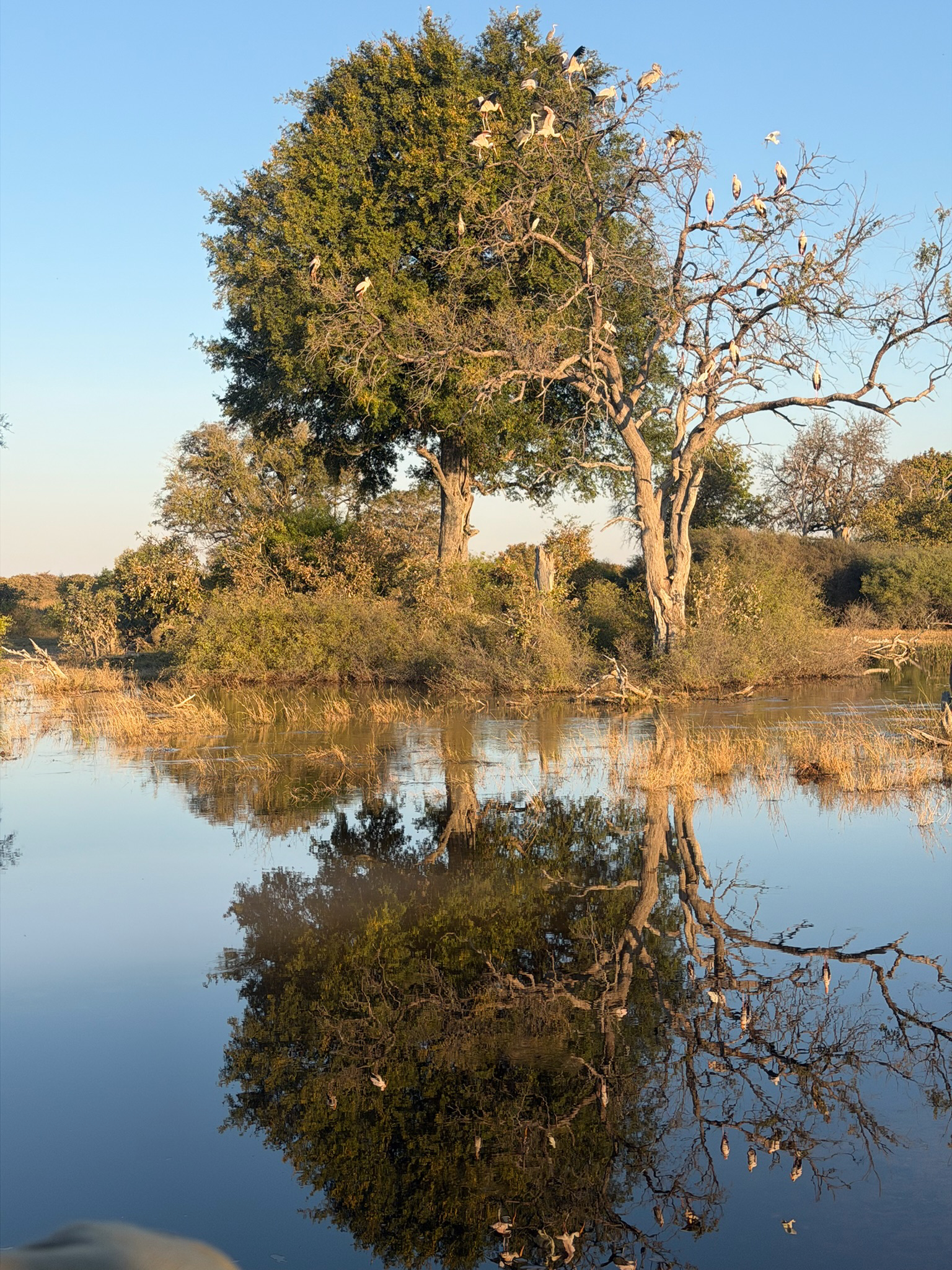
The habitat is the reason to come. Permanent waterways and swamp, floodplains that hold water year-round, tree islands, and drier mopane at the margins — which is what allows Vumbura to run land and water side by side rather than making guests choose an itinerary and live with the consequences.
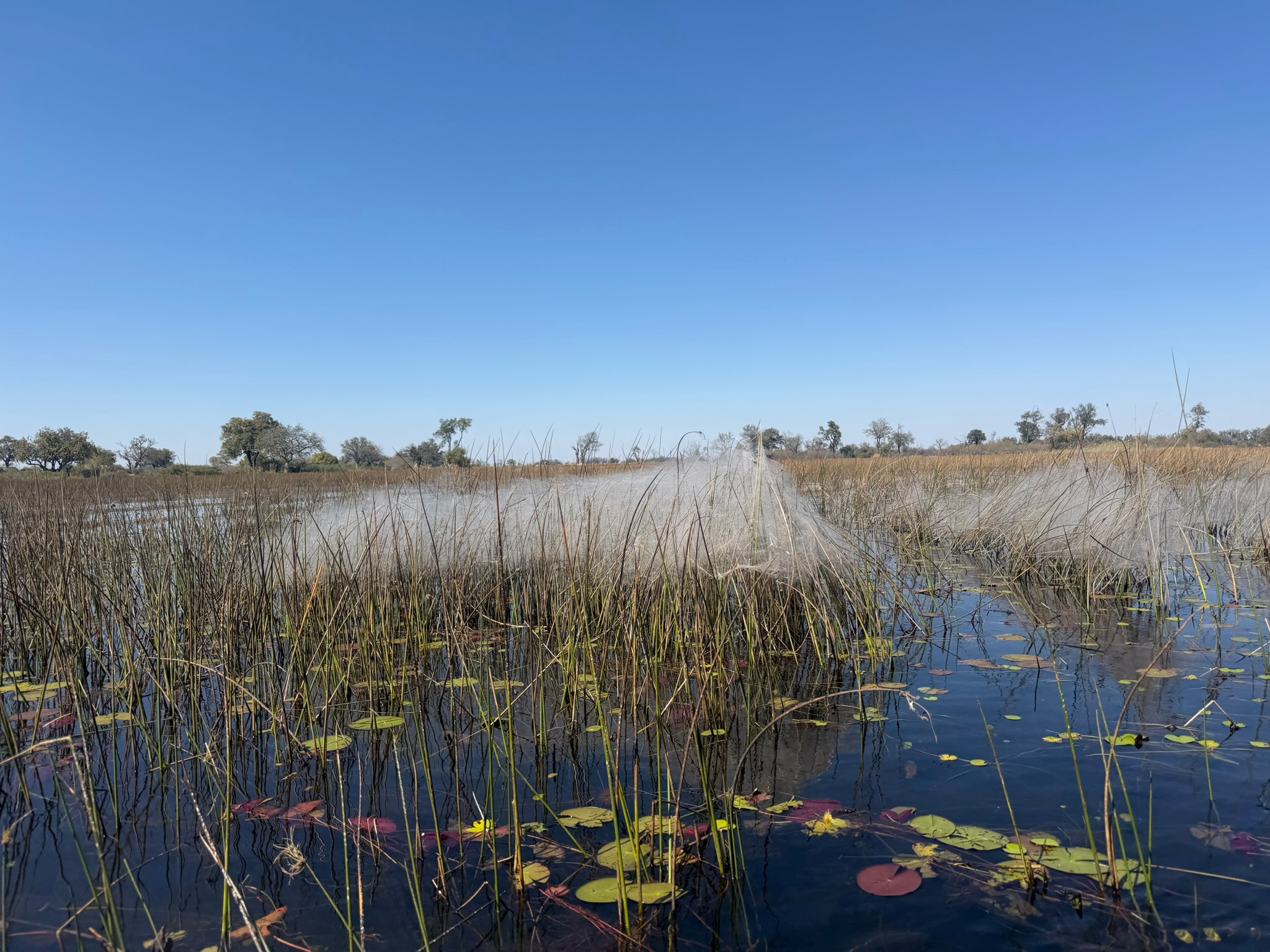
That word permanent is the single most useful thing to understand about this concession, and it is a function of where it sits. Vumbura lies at the top of the Delta, close to where the floodwater enters the system, on channels that hold water through the whole calendar rather than filling and draining with the season. Many Delta camps market water activities and then quietly withdraw them as the year wears on — the mokoro channels close, the boating shortens, and by late season the brochure and the reality have parted company. Vumbura does not have that problem. Boating and mokoro run here year-round, and a guest booking in November gets the same water this concession offers in June. In a flood year like 2026 that baseline simply rises.
Two camps share the concession: Vumbura Plains, split into North and South, and Little Vumbura.
We visited in an unusual year, and it shapes how this review should be read. The 2026 inundation was one of the strongest in recent memory. Parts of the Okavango took well over 1,000mm of local rain against an annual average nearer 450mm, and the seasonal push down from the Angolan Highlands arrived into a system already saturated. Water spread earlier and wider than it had in several seasons — floodplains and secondary channels were running by mid-May, and channels that normally close as the dry season wears on simply stayed open.
By early August the practical effect for guests was that the water activities were not a consolation prize squeezed out of a shrinking channel. The boating ran on real water, the mokoro channels were open, and the floodplains were carrying red lechwe in numbers. It also shaped the driving: more ground had to be gone around rather than through, which concentrated game on the islands and drier margins.
Weather was classic Delta winter. Cold enough before sunrise to want the blankets, warm and open by the middle of the day, and cooling fast once the light went. Cold enough, in our case, that a plunge pool three steps from the bed went entirely unused.
Facilities
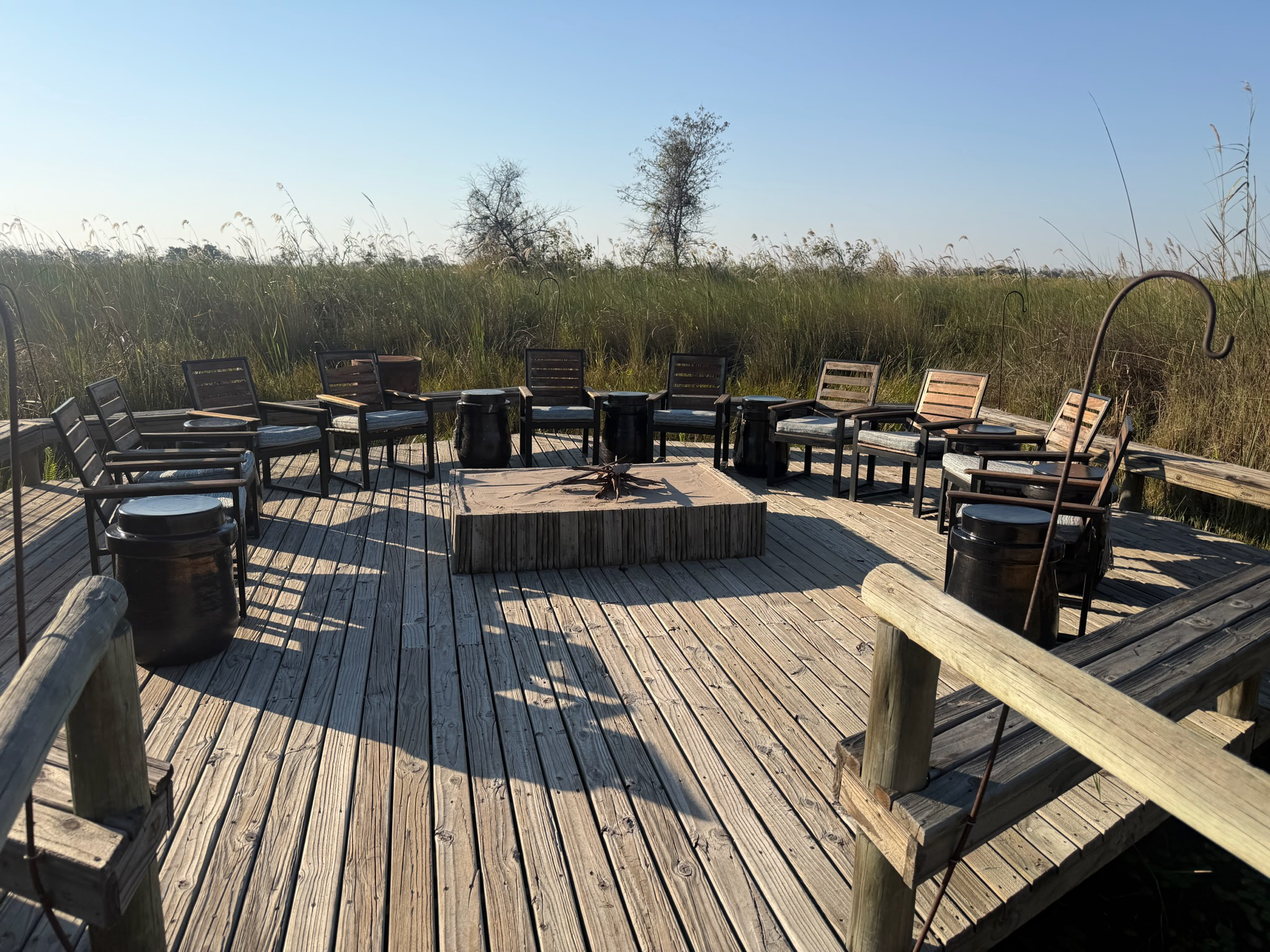
The facilities are beautiful and there are a lot of them, which is both the strength and, for me, part of the problem — more on that below.
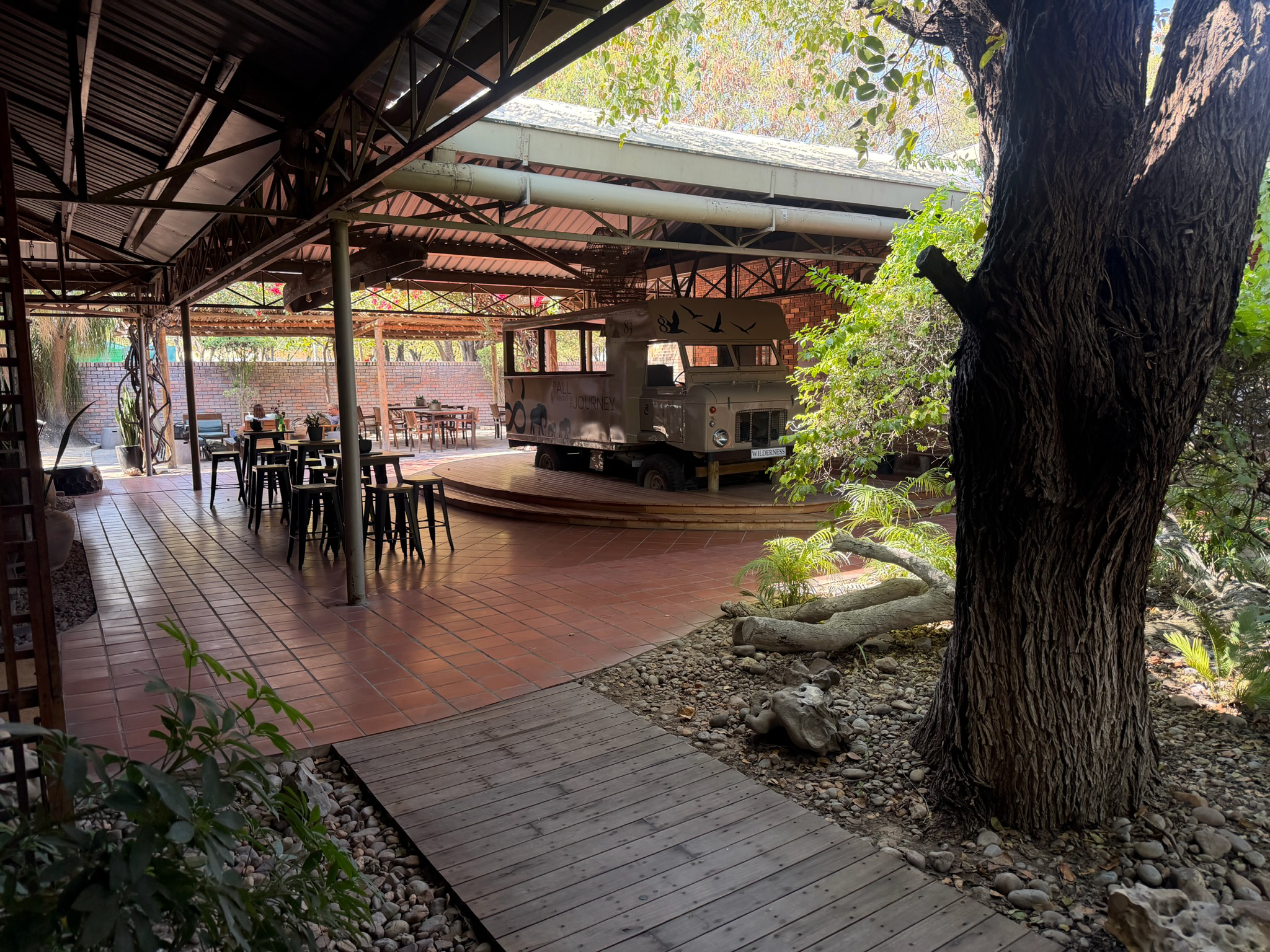
The main area at North has one principal bar but many places to drink, several boma areas, and a dining space with both indoor and outdoor seating that is genuinely lovely at either end of the day. There is a full espresso machine, which after enough camps stops being a small thing.
The boardwalks are the feature I did not expect to enjoy as much as I did. Raised walkways connect every tent to the main areas, and they continue all the way from North to South — a fifteen to twenty minute walk. In daylight hours you can do it unescorted, which meant I could actually get some steps in, and you can break the walk at the South camp bar for a drink on the way. For a camp of this size, being able to move under your own steam rather than waiting for an escort makes a real difference to how the day feels.
The shop sits on that walk, serves both camps, and is a good size with a lot of small, well-chosen gifts.
The craft market is the best thing in camp and it is not a facility at all. Roughly once a week the staff bring their own work into the main area at afternoon tea — basketry, wood carving — set it out, explain how it is made, and sell directly to guests, with the money going straight to the maker. They will also put a tool in your hand and show you how. John, one of the team, walked me through carving a small wooden mokoro and let me have a go at it — mine was not going home with anybody. His own work is another matter entirely: he had walking sticks and other carved pieces for sale, and they are good. The mokoros he carves are not for sale at all. The camp leaves one in each guest's room as a parting gift, which is a far better souvenir than anything in the shop precisely because you have met the person who made it. Mine broke on the journey home, and I am still annoyed about it. It is the clearest expression of what the community lease means in practice, and it is worth timing your stay to catch the market.
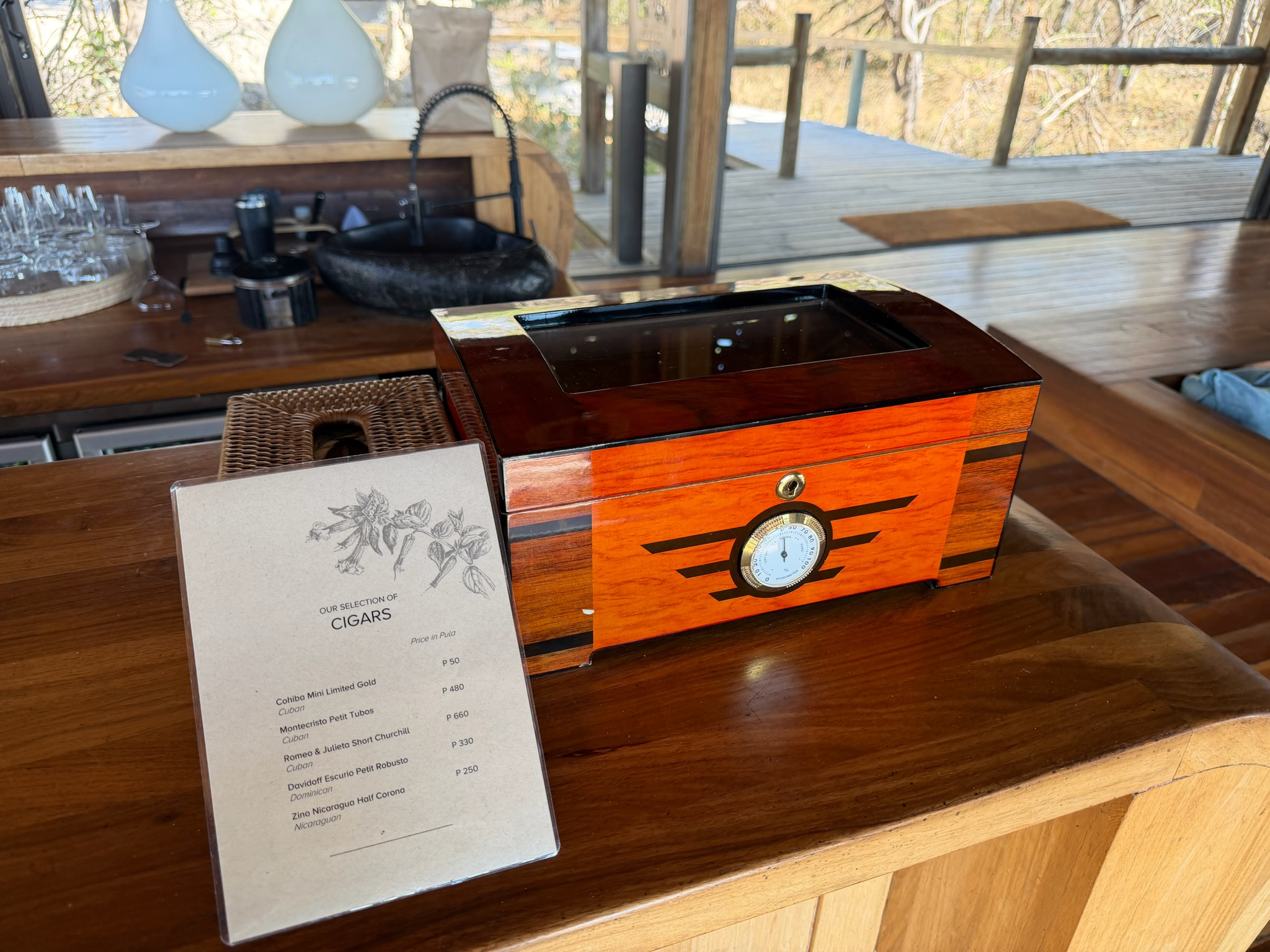
The bar keeps a humidor, well stocked with good Dominican and Cuban options. These are charged separately, in the same way fine wines and champagnes sit outside the standard drinks inclusion — worth knowing rather than discovering. Mo made full use of it on both nights and then spent the rest of the trip failing to find anything comparable anywhere else on our routing.
There is no camp pool, and no lap swimming anywhere on the property. Each suite instead has its own plunge pool on the deck — a cooling-off pool rather than anything you would swim lengths in. Given the layout and the views from the individual decks, that is the right trade rather than an omission, but anyone who swims for exercise should know it before they arrive.
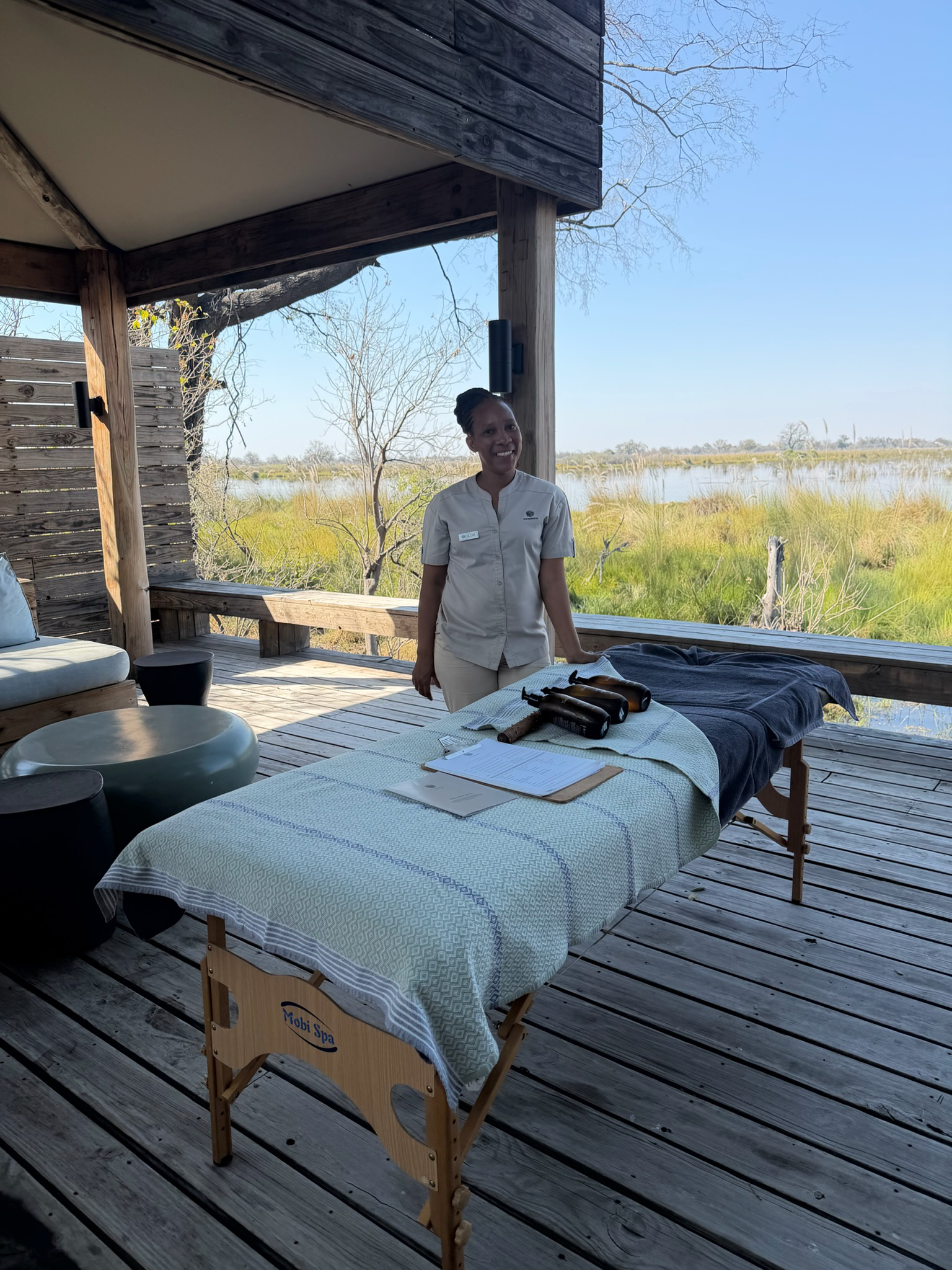
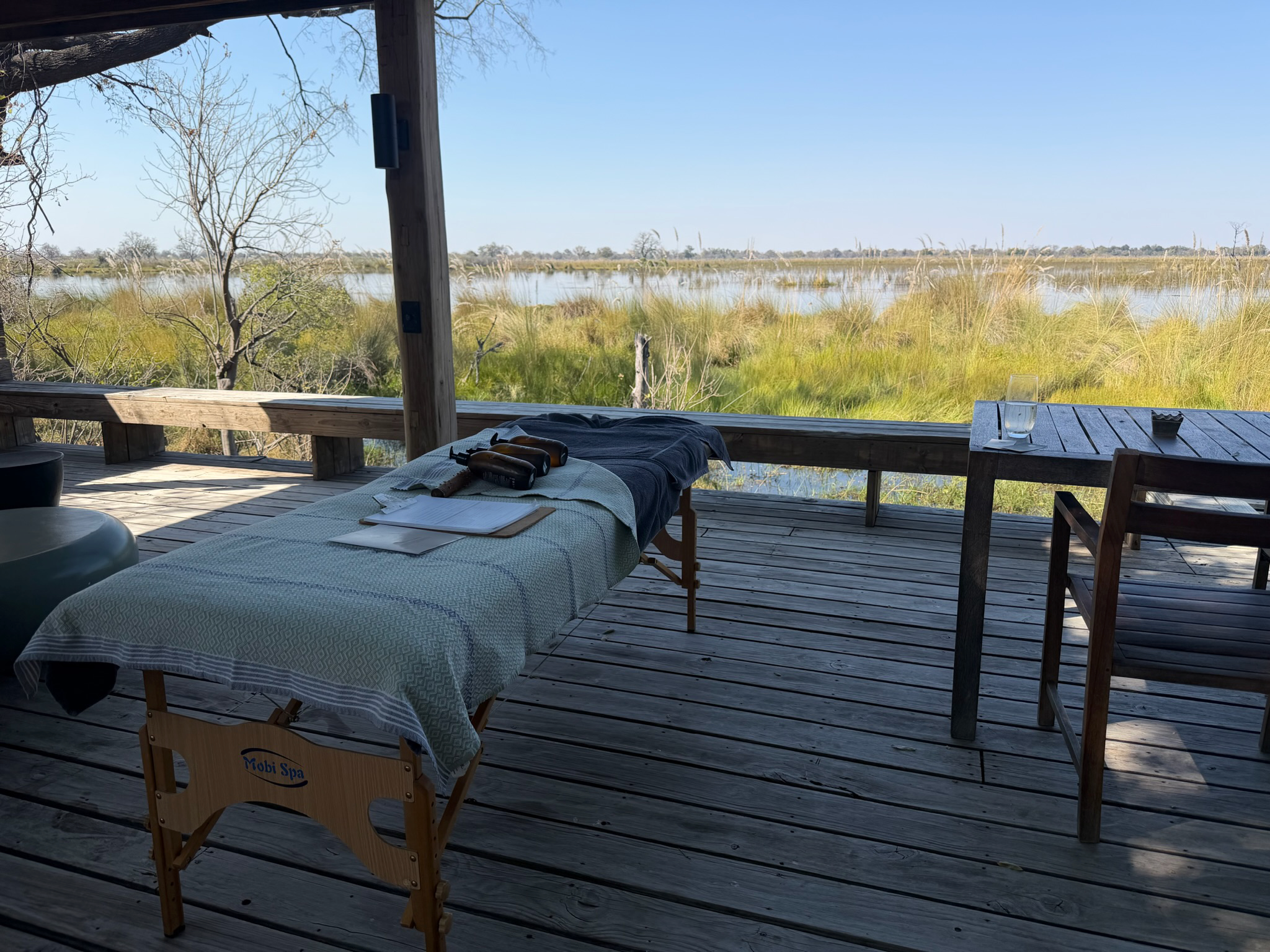
Massage is available in-tent on request at additional cost, and it is worth taking. I had one on the outdoor patio of my own room, looking out over the floodplain. The treatment itself was good rather than exceptional — I have had better at other camps — but the setting does a great deal of the work, and Gloria, who goes by Glow, was fantastic and knew exactly what she was doing. There is no gym or fitness facility.
Wi-Fi reaches the rooms only. That is dealt with properly in The Bad.
The Room
We took three of the six twin/double suites at North; the camp's other two units are family suites. All three were configured as doubles — we were each traveling on our own.
These are premier-tier rooms and on paper they have everything. Ours was essentially one enormous square, somewhere around a thousand square feet, with remarkably few interior walls. The bed sits centrally with a bank of closing wardrobes immediately behind it — their doors printed with large underwater photographs, a motif repeated on the shower screen — a desk to one side, and the shower and dressing area open to the room rather than partitioned away. The only real walls are a low screen at the shower, which you can still see over, and an enclosure for the toilet.
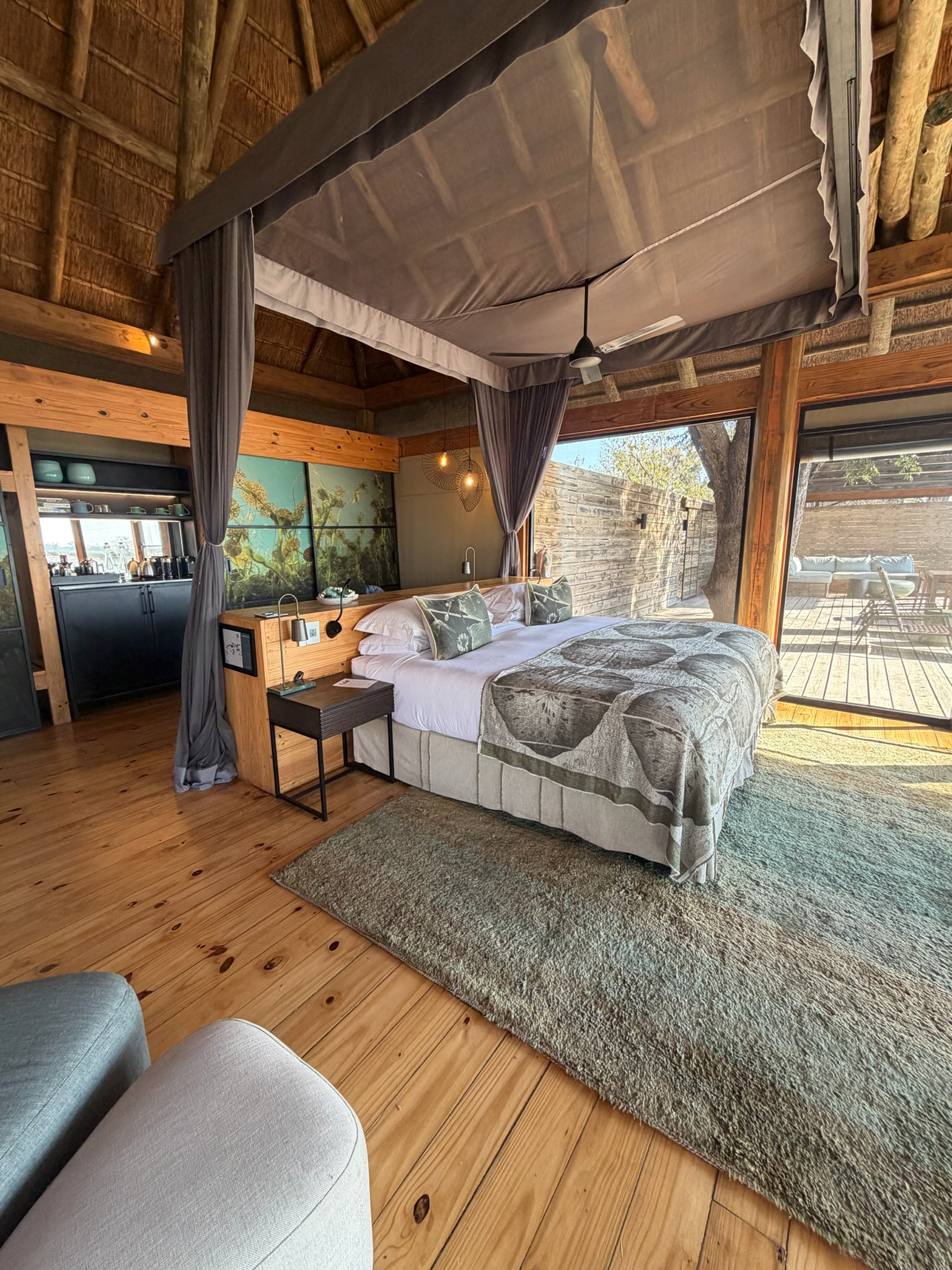
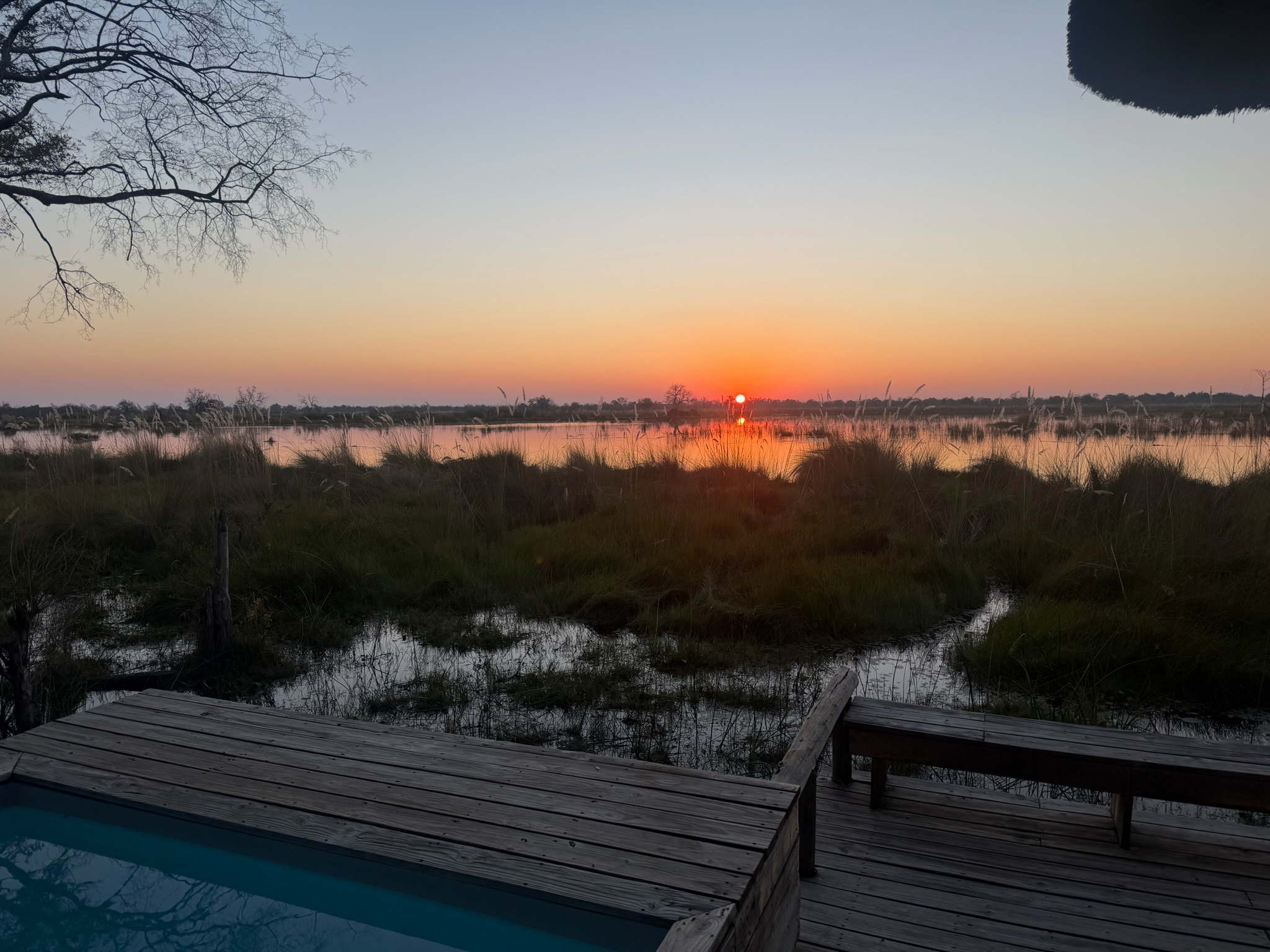
The suite opens on two sides. One gives onto an outdoor shower; the other onto a deck with a private plunge pool, a couch, a covered sala, and room to spread out. The view is the reason to book here. In a flood year like 2026 the water simply runs to the horizon — lechwe moving through it, and the light doing extraordinary things twice a day. I never used the plunge pool. In early August it is simply too cold.
And yet. This is the section where I have to be honest about something that a specification sheet will not tell you. The room did not hold me. It is very large, the ceilings are high, and the effect is more expansive than intimate — it felt big, and slightly impersonal, in a way the rebuilt suites at Chitabe emphatically did not. The finishes are also beginning to show their age; this is a room that would benefit from a refresh to bring it up to the standard of the price being charged for it. None of that makes it a bad room. It is a beautiful space. It is simply not one that made me want to stay in it, and at premier tier that matters.
The open plan is worth flagging as a booking consideration too. It is designed for a couple. Anyone sharing who wants genuine separation — adult friends, a parent and an adult child — should understand the layout before they book.
On cooling, be clear before you book: there is a ceiling fan and that is all. No air conditioning, and no evaporative cooling of the kind Wilderness has installed in some of its rebuilt camps. The suites rely on natural ventilation and the height of the ceilings, and the camp runs primarily on solar with generator backup. In early August this is a non-issue — the nights were cold enough that the fan mostly went unused. In the hot months it is a real consideration, and guests traveling October through March should weigh it. There are plug points for charging, and the minibar is fully stocked in the Wilderness manner — spirits, beer, wine, mixers — with anything missing arriving on request.
Privacy is well handled. The neighboring suites are not far off, but the orientation and screening are good enough that I never saw or heard one from my deck.
The Vehicle
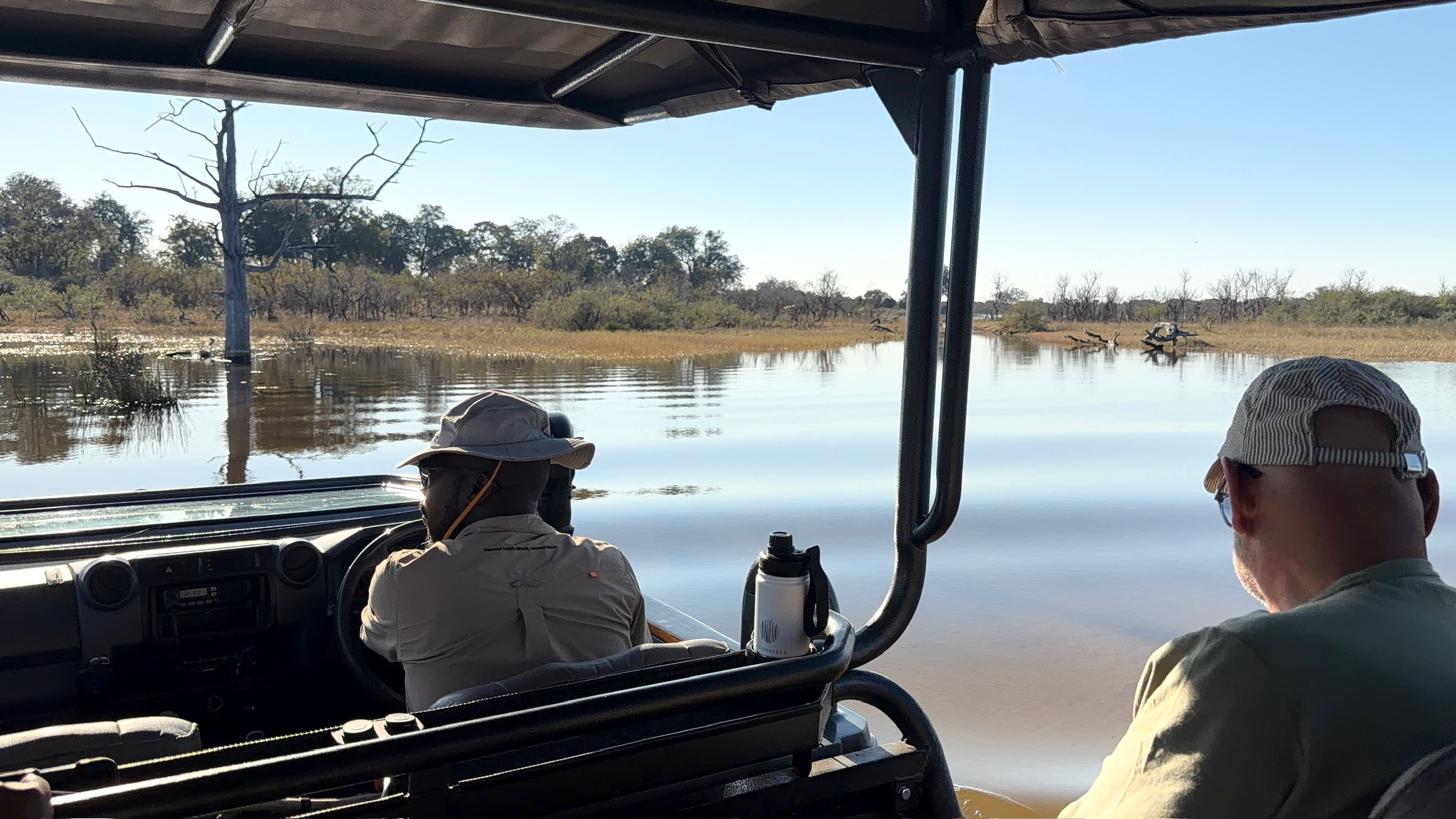
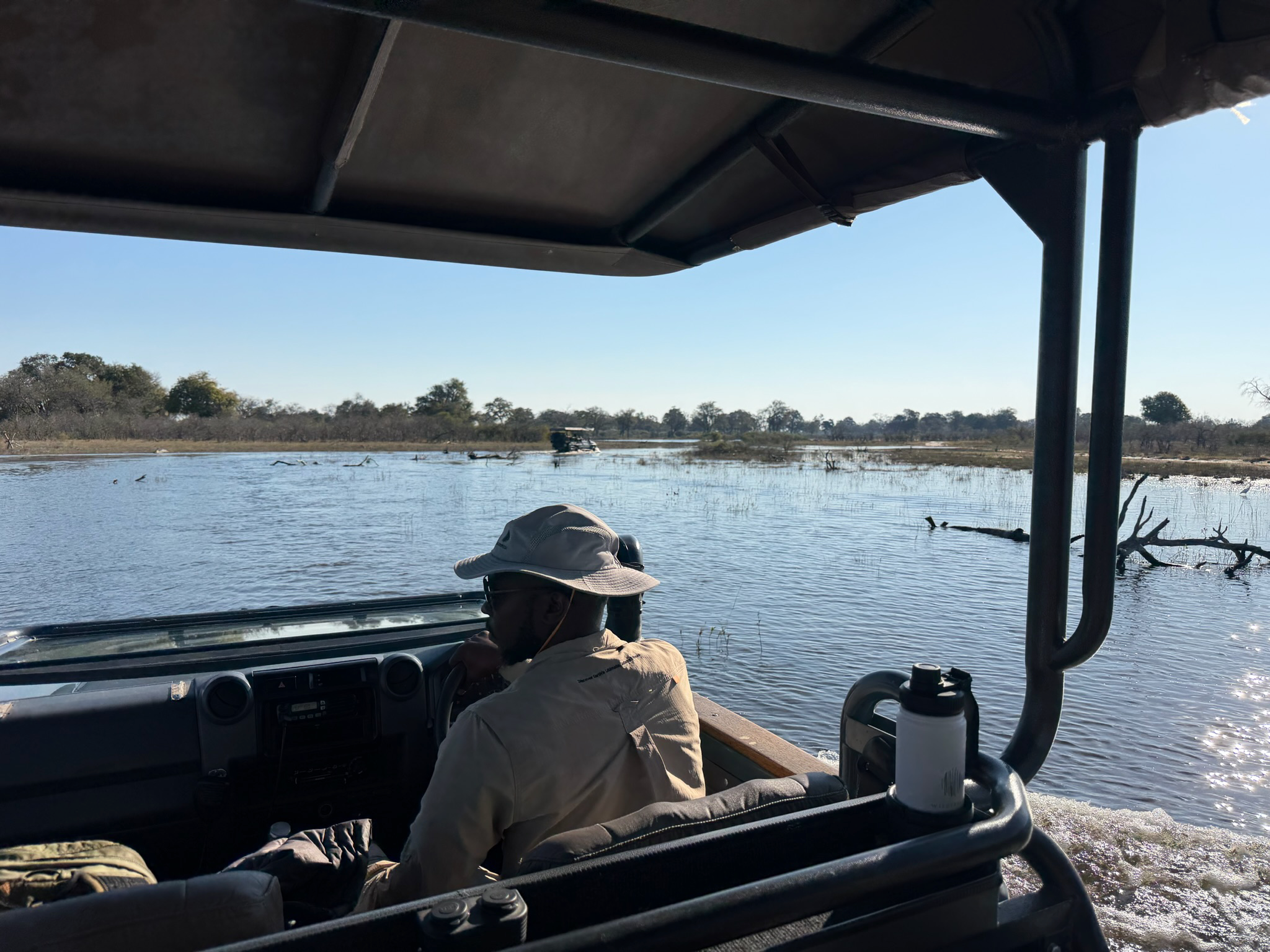
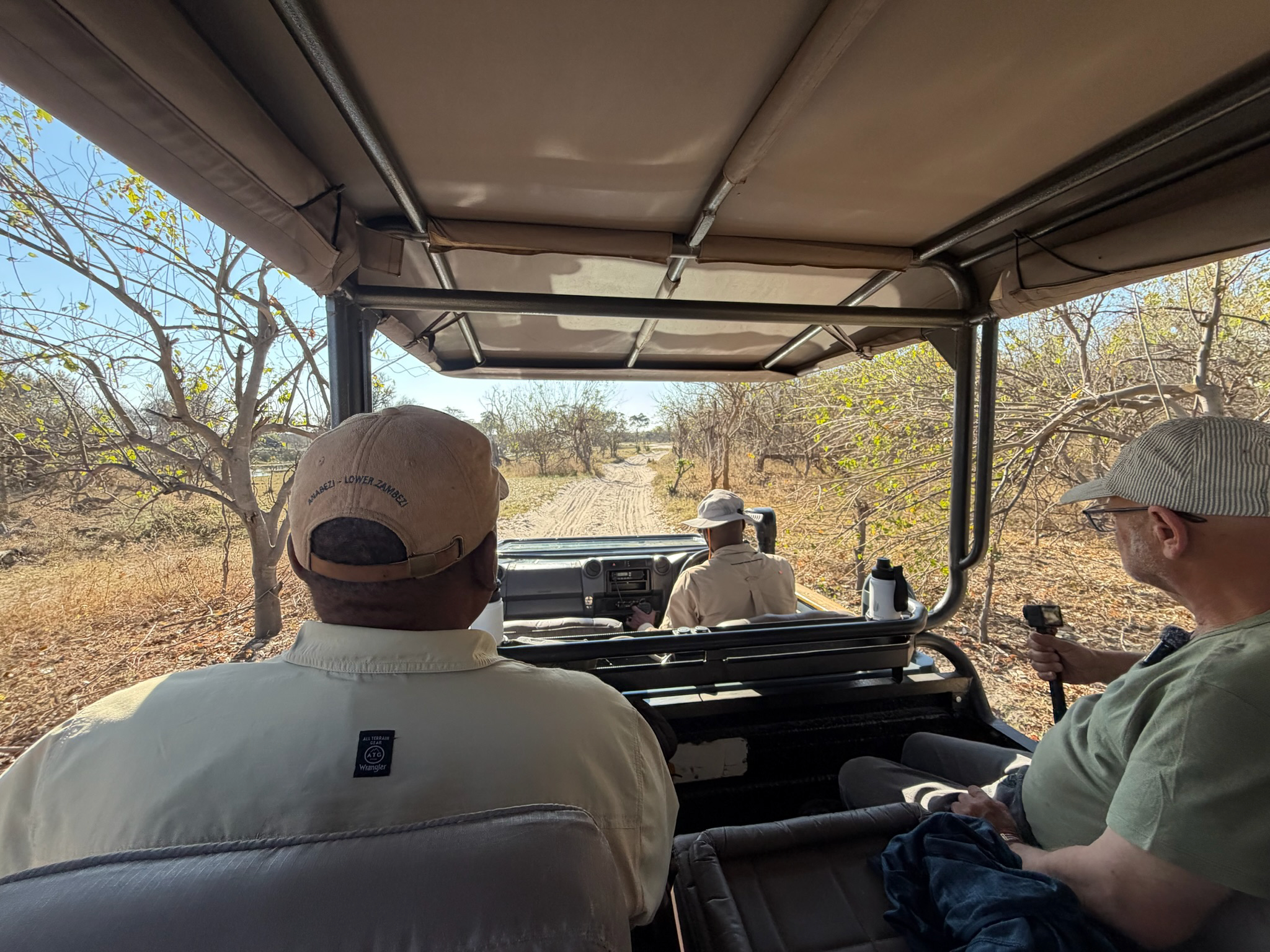
Vumbura runs the standard Wilderness open Land Cruisers, and they are comfortable, well maintained, and entirely fit for purpose. They seat six, though premier camps generally cap them at four, and we did not have to share ours at any point.
There are charging points at the seats. There are no bean bags or camera supports — which is not specific to Vumbura but a fleet-wide pattern across Wilderness, and photographers should plan around it rather than be surprised by it. Bring your own beanbag.
The balance between vehicle and boat is worth setting out honestly, because Vumbura's reputation as a water camp can leave guests assuming the driving is an afterthought. It is not. We took two full game drives — the afternoon we found the tree-climbing lions, and the morning at the wild dog den — alongside a boat cruise, a mokoro, and the boat transfer in. Both of our best sightings came from the vehicle. What the concession offers is genuine parity: the driving is real driving, and the water is real water, and you are not trading one away to get the other.
Food
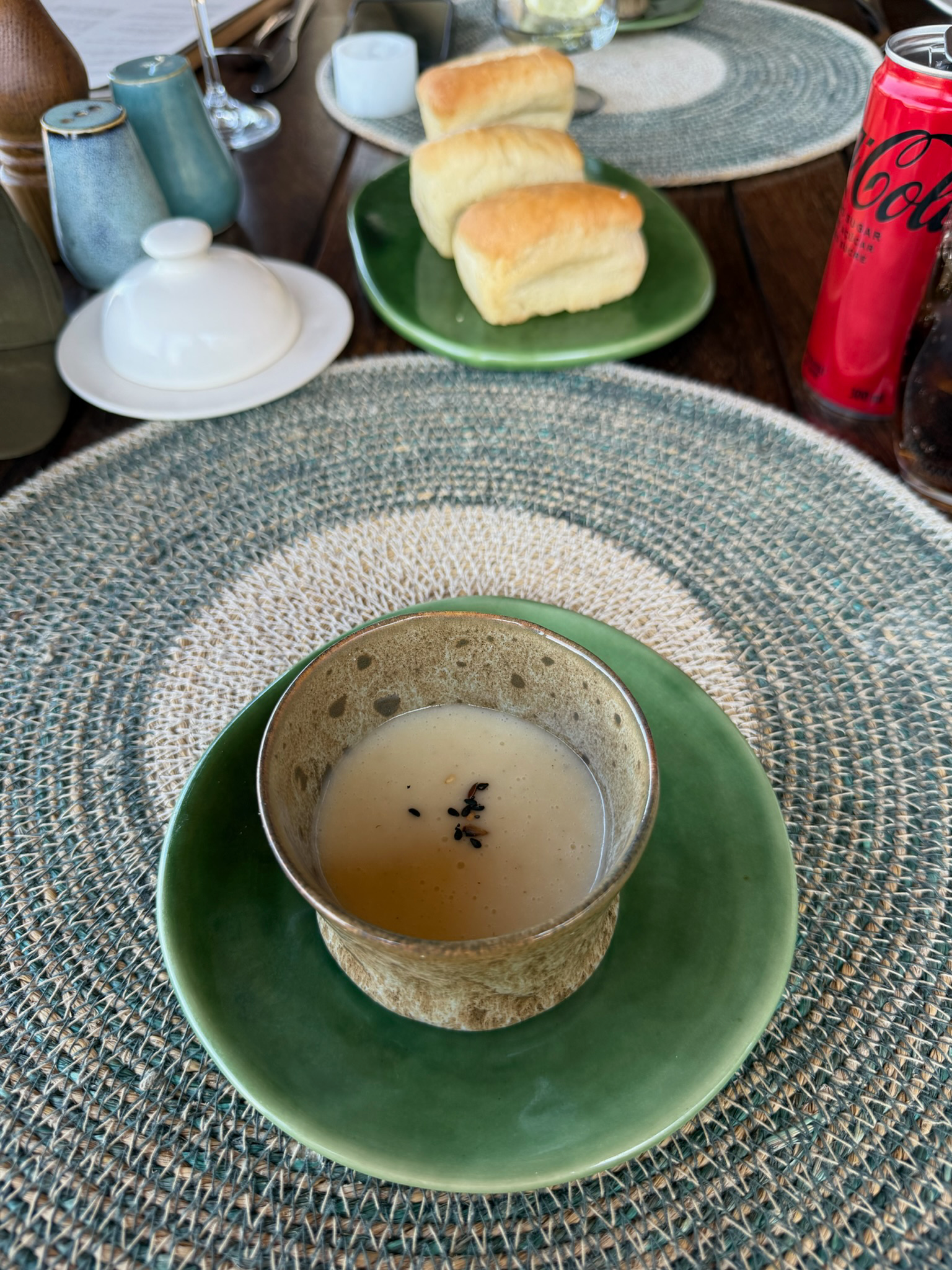
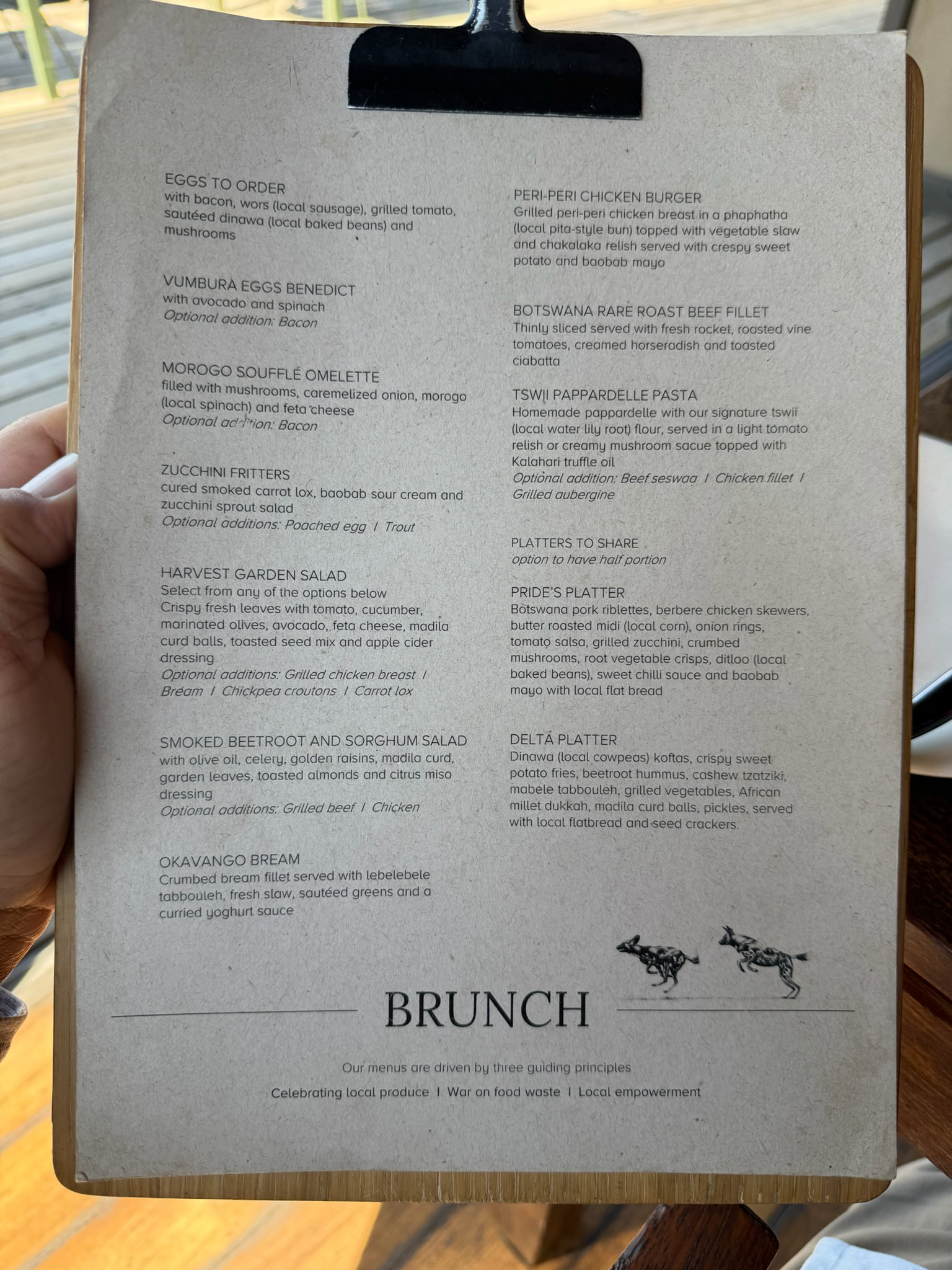
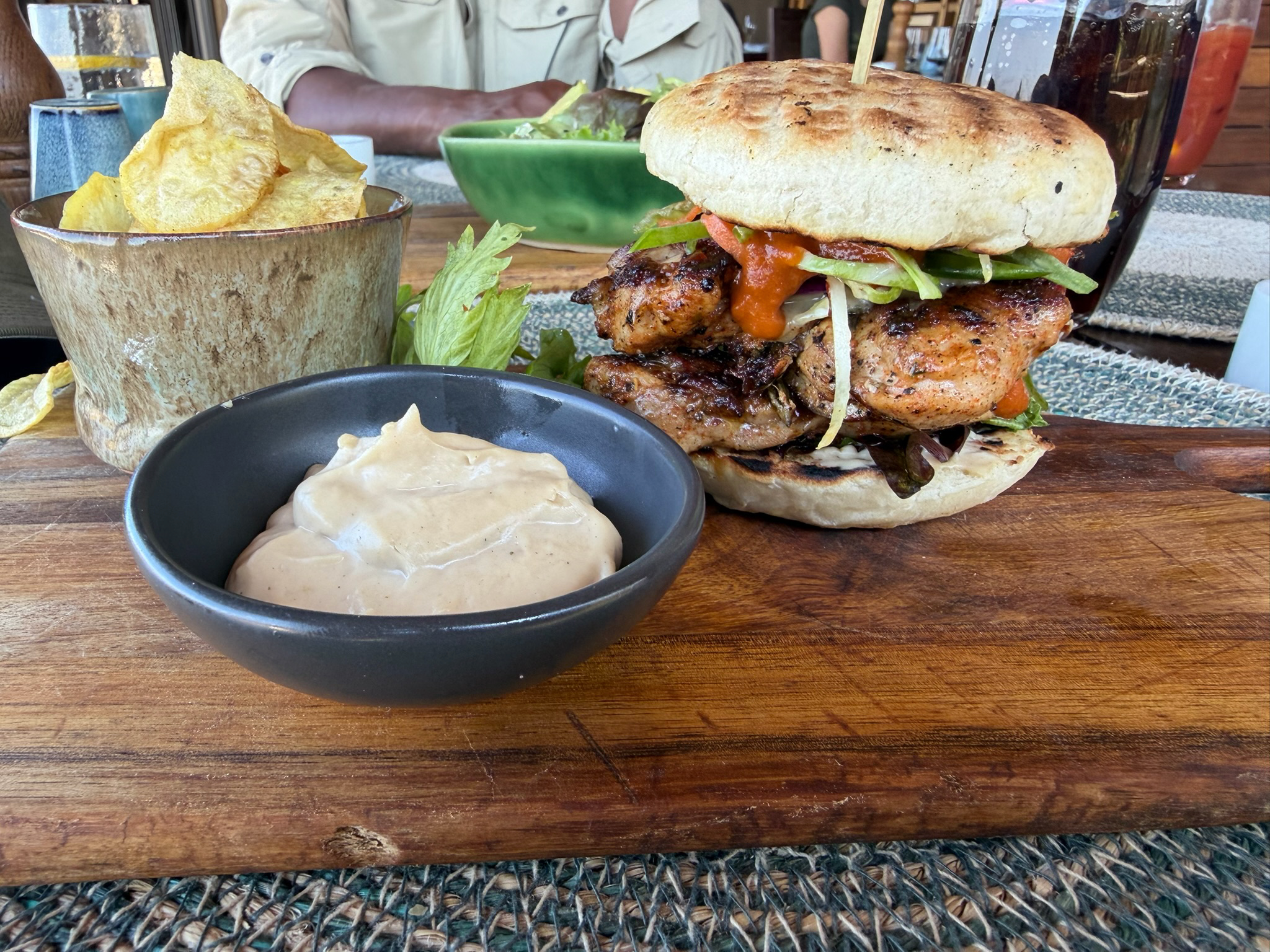
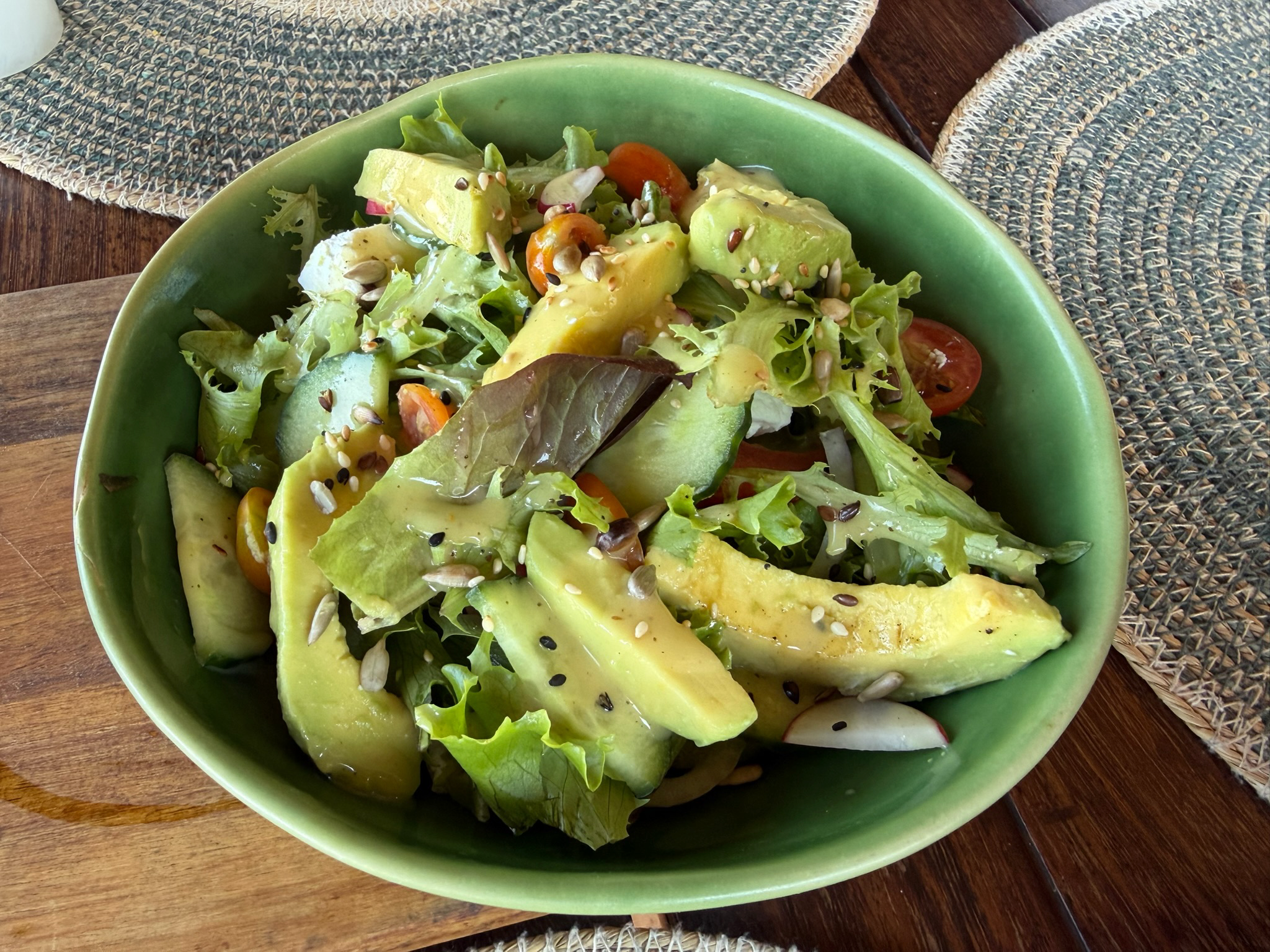
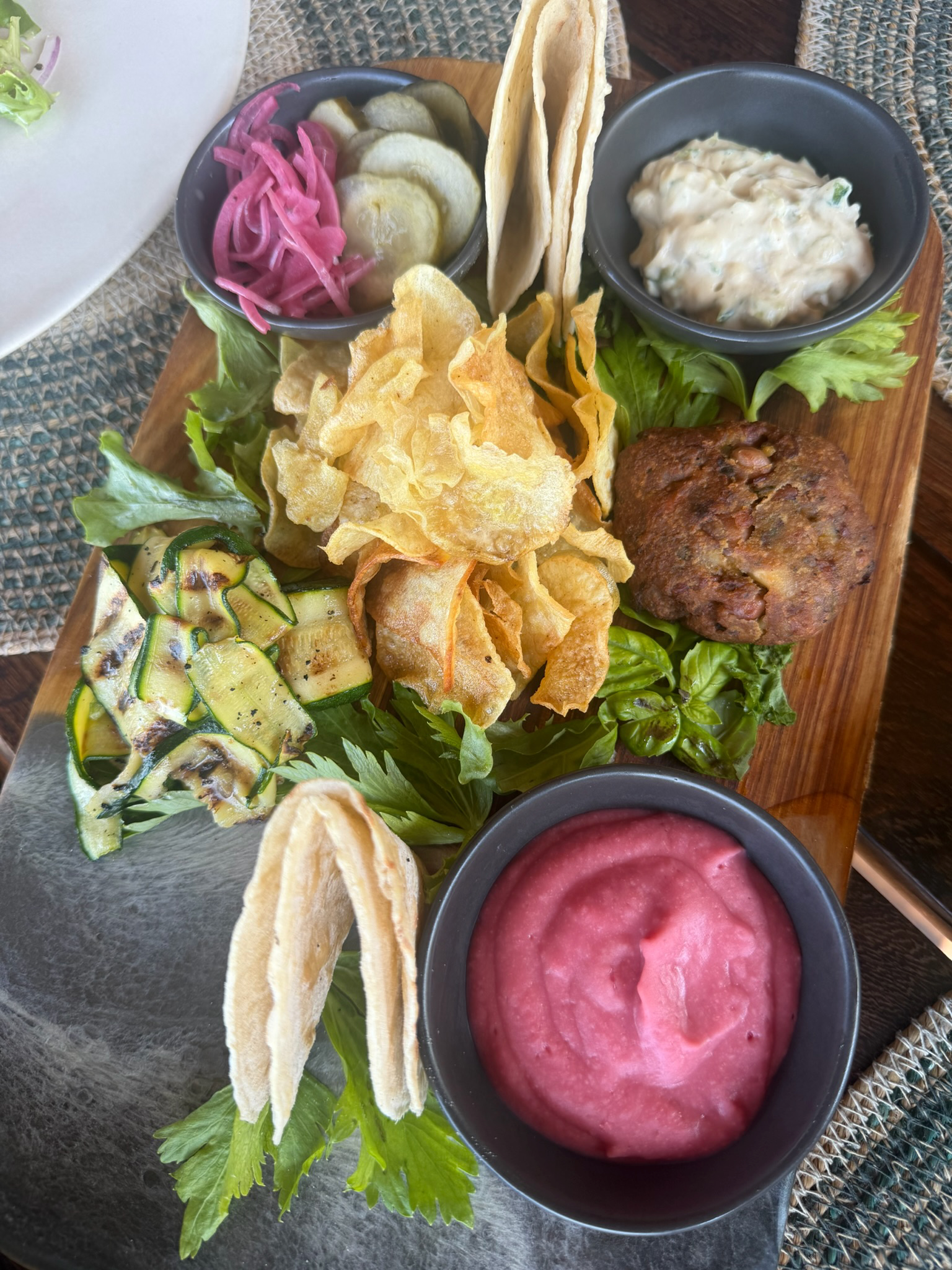
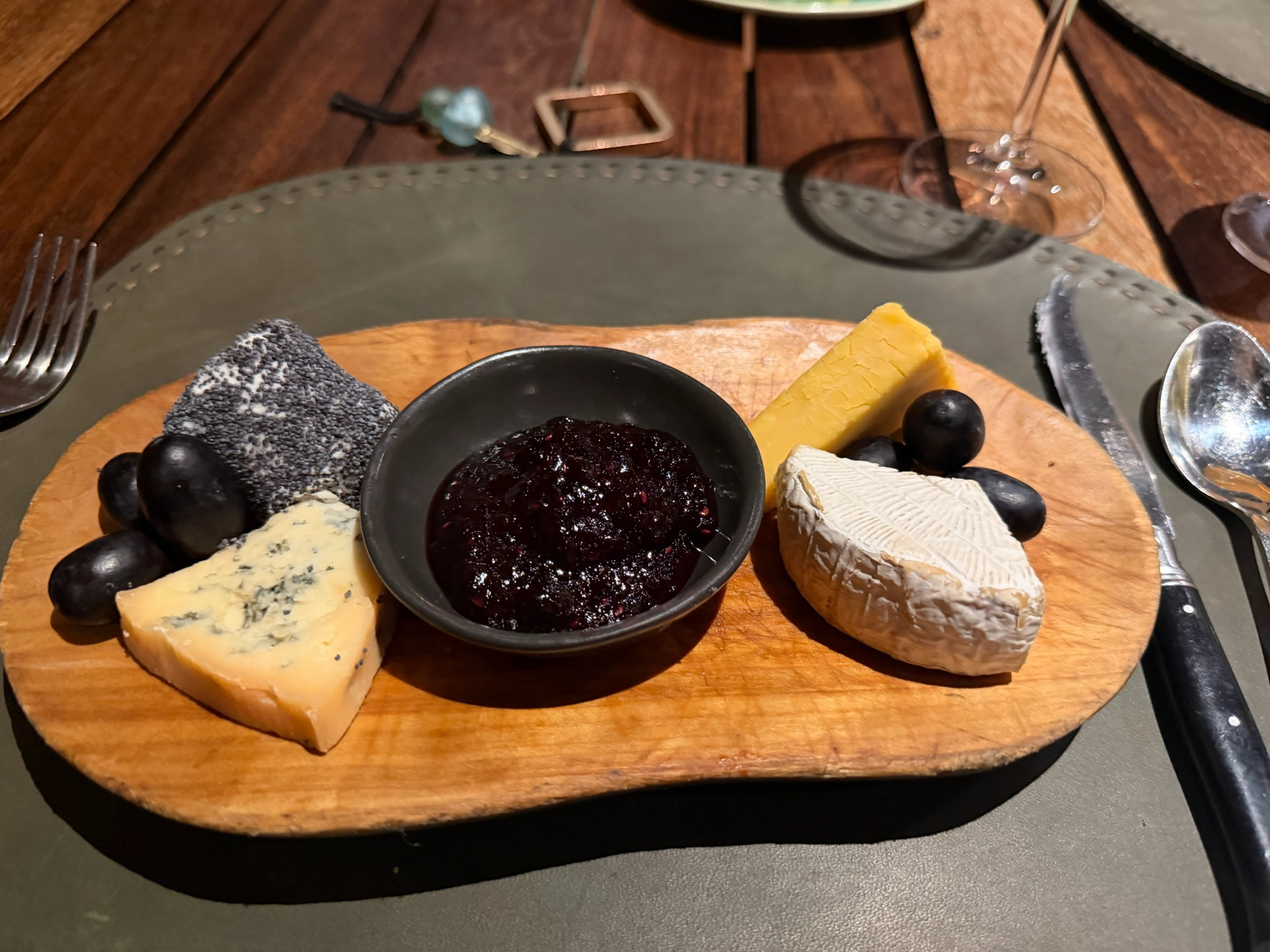
Food is a real strength, and it is served at the standard the tier implies: lunches and dinners are plated, multi-course events rather than buffets, with a proper range of choice at each.
Arrival lunch on the first day is the lighter format — small plates ordered from a menu, salads, the familiar Wilderness style, which is the right way to feed people who have just come off two flights and a boat.
Both dinners were excellent. The filet on our second night was outstanding and cooked exactly as asked. Across two nights there was nothing I would send back and nothing that felt like it had been assembled rather than cooked.
Breakfast is a hot buffet, set out early and eaten before the morning departure. It is included, as it is for all our guests.
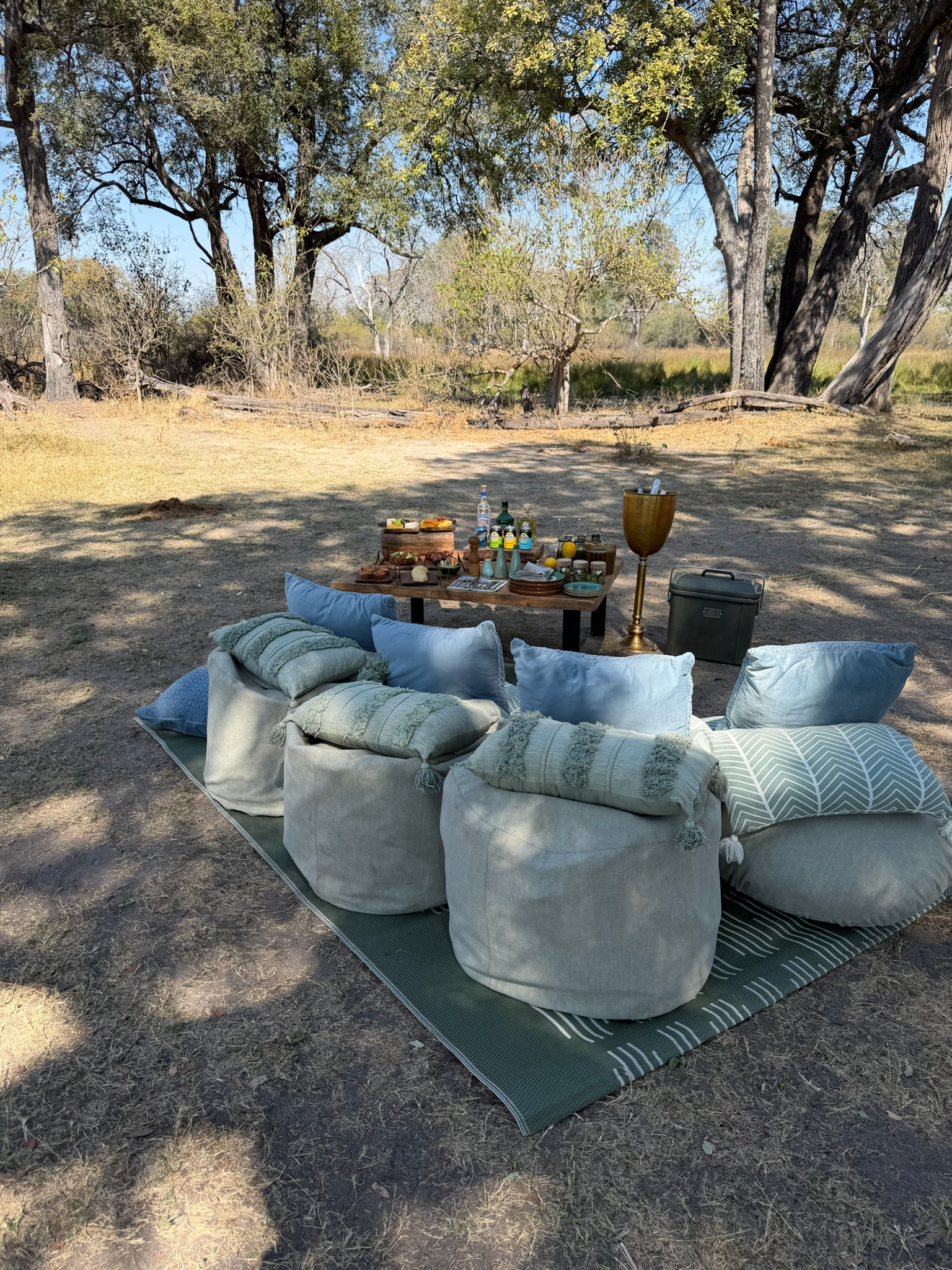
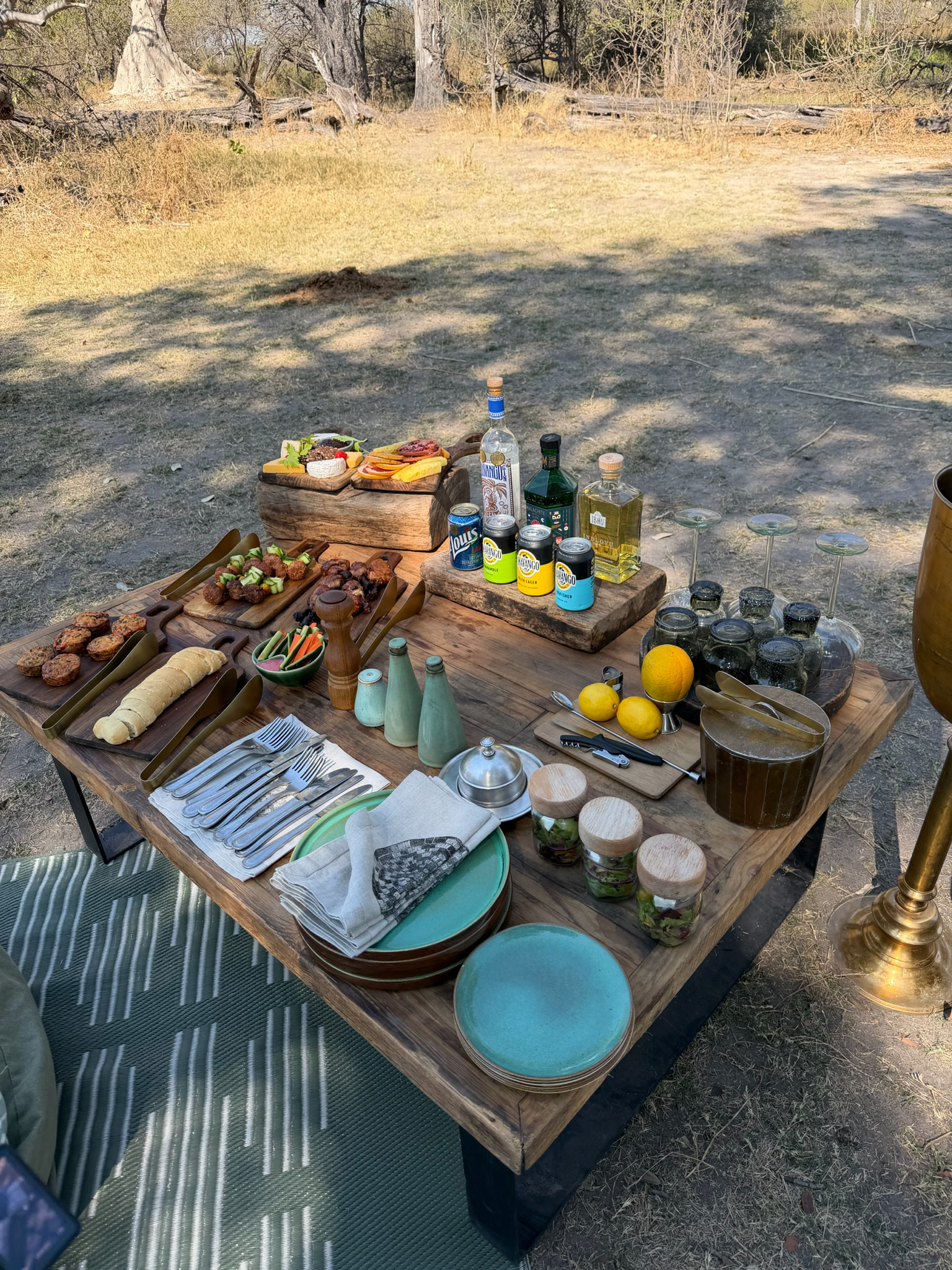
The bush lunch on our second day deserves its own paragraph, and an honest caveat. It was extraordinary: a full setup out in the concession with gin and tonics, wine, bubbles and sodas, a vegetable quiche, beef meatballs, chicken, salads, fruit and cheese — taken in the middle of the bush at the end of a morning that had begun at a wild dog den.
It is not, however, something guests should arrive expecting. Benson asked the camp to arrange it and they did, which is one of the quieter benefits of traveling with a private guide who has long relationships with these camps. You can always ask. And if it appeals but you are not traveling with a private guide, get in touch and we will see what we can arrange.
Drinks are included in the standard Wilderness fashion and the range is generous, the humidor at the bar included.
Service
Service at Vumbura is warm, well drilled, and genuinely good. The manager met our boat on arrival and was on the jetty again every evening we came back in, which is a small ritual that does a lot of work.
The person who made this camp is Tumelo, who hosted us throughout. His spirit, his attitude, and his smile are what we will remember about Vumbura, and I do not write that lightly about a property I have just criticized for feeling impersonal — Tumelo is the reason it did not feel that way more often. He was present without hovering. He knew what every guest in camp was doing and where they were in their day. And he ran his team with a lightness that never tipped into looseness: everything was handled, nothing was fussed over, and all of it came with a smile that was clearly his own rather than a uniform.
A word too for George in the dining room, who gave us outstanding service across every meal. There is a nice story attached. George worked with Benson years ago at Savuti, the Linyanti camp Benson used to run, and neither knew the other was at Vumbura — we tend to book Little Vumbura on this concession rather than the Plains, so the two of them had simply lost track of each other. Watching them work out who they were across a dining room is the kind of thing that happens in an industry where the good people keep circling back to one another.
Mike, the general manager at North, was visible in camp and came over to talk on a couple of occasions.
The best evening of the stay came on our last night, when we invited Tsono to join us for dinner. Watching Benson — who ran Little Makalolo and Savuti before starting his own operation — talk a younger Wilderness guide through guest management, and through what actually helps out in the field, was the kind of thing that happens at a camp table and nowhere else. Tsono listened properly. That is its own recommendation.
That said, this is premier tier, and the standard has to be held there. One exchange did not land. The general manager came over and made conversation about where we had been and what we had seen that day, in a manner suggesting he already knew — and he had it comprehensively wrong. It was funny rather than offensive, and we let it go. But at this price point the guest-tracking behind that kind of conversation needs to be real. Either know what your guests did today, or ask them. The performance of knowing, done badly, is worse than either.
Activities & Guiding
Vumbura offers game drives, motorboat cruises, mokoro excursions, guided walking, and catch-and-release fishing, with helicopter flights available at additional cost. The genuine selling point is that in a year like this one you do not have to pick — you can drive in the morning and be on the water in the afternoon, and both will be good.
Our guide was Tsono, and he was among the best we have traveled with anywhere. He guided us solo, without a tracker, for the entire stay. What follows is the evidence rather than the adjective.
On our first afternoon we went out by vehicle. The water was everywhere and the birding was immediately extraordinary — the Delta at full flood is one of the great birding environments anywhere, and Tsono could name every single thing we put in front of him. My running joke that the birds were the boring part did not survive the trip. There were red lechwe throughout, and the driving itself was beautiful simply as an experience of the place.
We spent part of that afternoon looking for a leopard, and the story of the one we did not find says as much as the ones we did. Tsono had already seen a civet hoisted into a tree, knew the young male — around two years old — had made the kill, and had noticed that he was not eating it. Civets carry perineal scent glands, and predators fairly often kill one and then abandon it; the musk that makes civet valuable to perfumers makes it unappetizing on the plate. That is the kind of detail a guide either notices or does not. We never found the leopard.
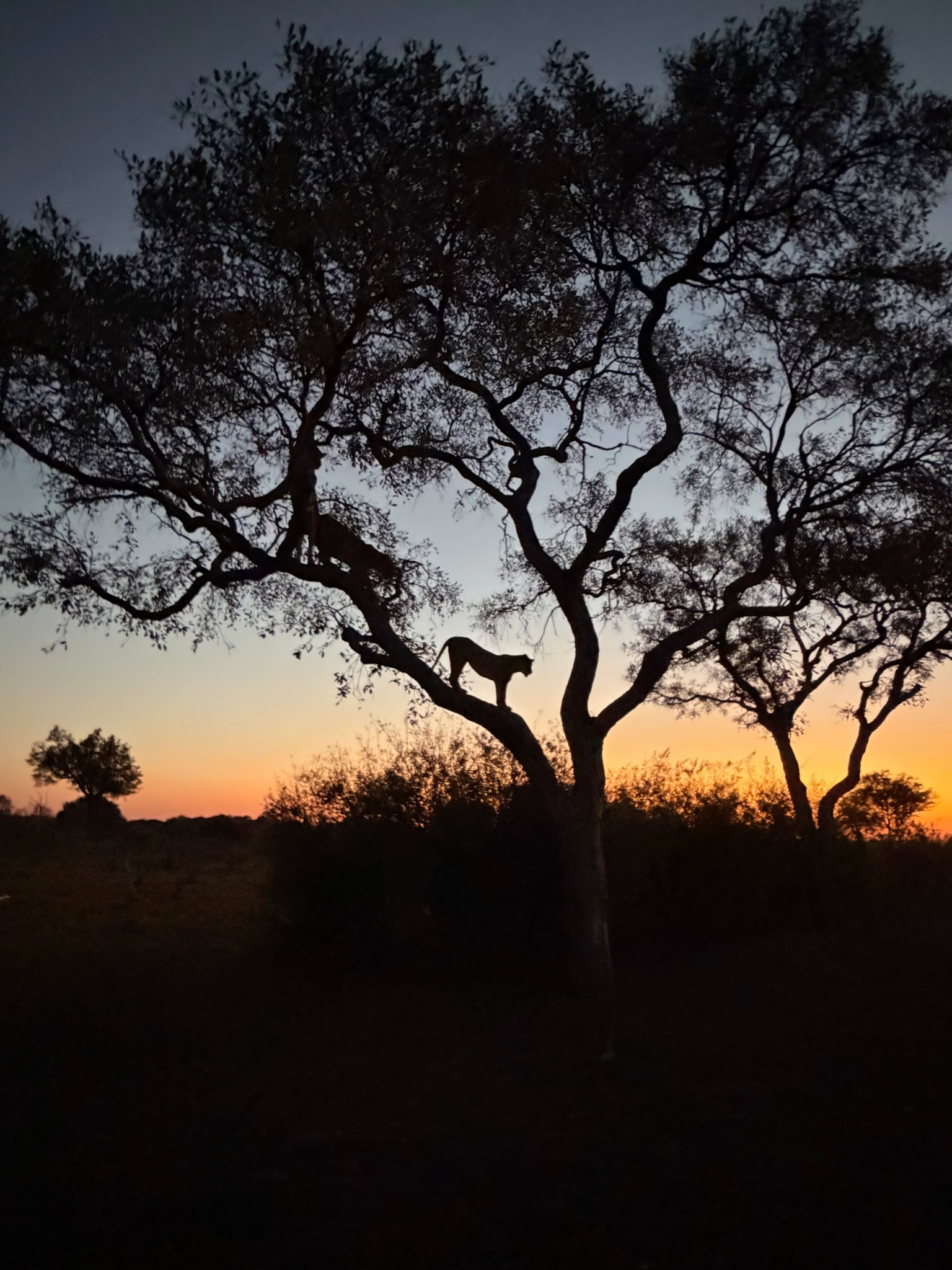
What we found instead, heading back toward camp, was five lions with four of them up a tree. The three of us were doing what guests do and scanning the ground. Tsono and Benson were looking up, because they had already worked out what we had not — that in a concession this wet, lions get off the sodden ground and away from the insects by climbing. Delta lions in trees is not something we would have thought to look for. Without him we would have driven straight past, and we watched them instead through the last of the light.
The second morning was the wild dogs. Tsono knew the pack was denning on the western side of the concession, and — more usefully — he knew when to be there: early, while the pups were still balled up against the cold and before the adults broke off to hunt. We arrived to roughly seventeen or eighteen pups and around thirteen adults. The pups came loose as the sun got onto them and began playing; some of the adults moved off to hunt while we watched. General game was quieter after that, though the plains game was good, and the morning finished with the bush lunch described above.
The second afternoon we took the boat instead of the vehicle, out to the lagoon and on to Little Vumbura. This is where a different kind of competence showed. Driving in high water is a real skill — reading channels, and above all handling hippos, which in a flood year are everywhere and are not always where you would like them to be. Tsono did it calmly and confidently, and never once made it feel like a situation. Guests rarely think to ask about a guide's water handling when they book a water camp. They should.
On our final morning Mo went out on a mokoro and was back by a quarter to ten, which is the right way to spend a departure-day morning in the Delta.
I would recommend Tsono to anyone going to these camps, and we will be requesting him for our own guests. That is the strongest thing this review says about anyone.
Vumbura Plains or Little Vumbura?
We took the boat across to Little Vumbura on our second afternoon and walked into camp — partly for the obvious sentimental reason, and partly because we had guests booked to visit and wanted to see how the rooms and facilities were holding up. We talked to the staff and the managers and looked through the rooms.
Little Vumbura is a classic-tier camp of six tented suites on a small island reached only by boat, and it is not as luxurious as Vumbura Plains. It is also small, quaint, and close to perfect at what it is. Five years on from our honeymoon it remains a wonderful little water camp, and for a certain kind of guest it is emphatically the better choice on this concession.
The choice comes down to what you want from a camp rather than what you want from the land, because the land is the same. Both sit on the same concession, with the same water, the same guiding pool, and the same game. Vumbura Plains gives you a large premier-tier room, a plunge pool on your deck, plated multi-course dining, two family suites at North, and the scale that comes with thirty-two guests across two camps. Little Vumbura gives you six tents, an island, and a camp small enough to know you.
If your priority is the room and the polish, book Vumbura Plains. If your priority is intimacy, book Little Vumbura. Knowing my own preferences, and having now done both, I would find it hard not to point people toward the smaller camp.
The Good & The Bad
| The Good | |
|---|---|
| Tsono. | Among the best guides we have experienced anywhere. He found treed lions nobody was looking for, timed the wild dog den correctly, read the civet kill, named every bird in the Delta, and handled high water and hippos without ever making it feel like a situation. |
| Tumelo. | Our host, and the single biggest reason this camp felt personal. Present, aware of every guest in camp, running his team with genuine warmth rather than procedure. |
| George in the dining room. | Outstanding service across every meal, and an old colleague of Benson's from Savuti who neither of them expected to find here. |
| The concession. | Kwedi in a landmark flood year, bordering Moremi, with permanent water, floodplains, tree islands, and mopane all within reach of one camp. |
| Year-round water. | The concession sits high in the Delta on permanent channels, so boating and mokoro run all twelve months rather than shrinking away late in the season. Very few water camps can say that honestly. |
| Land and water at parity. | You are not choosing between a drive and a boat. Both of our best sightings came from the vehicle, and the boating was still excellent. |
| The wild dog den. | Roughly seventeen or eighteen pups and thirteen adults, reached early enough to watch the pups come loose and play as the sun rose. |
| Tree-climbing lions. | Five, with four of them up a tree — a behavior driven by wet ground and insects, and one most guests would never think to look for. |
| The birding. | The Delta at full flood is one of the great birding environments in Africa, and it converted a skeptic. |
| The community lease made visible. | The Okavango Community Trust structure is not marketing here — the villages are represented on the team. The craft market at afternoon tea sells directly to the maker, the staff will teach you how it is done, and the carved wooden mokoro left in your room as a parting gift was made by one of them. |
| The boardwalks. | Raised walkways to every tent and all the way through to South Camp — fifteen to twenty minutes, walkable unescorted in daylight, with a bar at the far end. |
| The food. | Plated, multi-course, with real choice. Both dinners excellent and the filet outstanding. |
| The bush lunch. | A full setup in the concession after a morning at the den. Ask for it. |
| The humidor at the bar. | Exactly the sort of detail premier tier should get right, and the only place on our routing that had one. |
| A massage on your own deck. | Taken outdoors above the floodplain, with Glow, and the setting alone makes it worth booking. |
| The espresso machine. | After enough camps, this stops being a small thing. |
| The Bad | |
|---|---|
| Connectivity. | Wi-Fi reaches the rooms only — no usable signal in the main area, the bar, or the dining room. In daylight that means walking yourself back down the boardwalk, which is no hardship. After dark, when guests are escorted, checking email means asking a staff member to walk you to your tent and back again. And once connected it is slow, noticeably slower than Chitabe and slower than most of our Botswana routing. Trade listings still describe Vumbura as having no connectivity at all, so what exists is an improvement on the published specification — it simply has not caught up to the price. |
| The room needs a refresh. | It is large, high-ceilinged, and beginning to show its age. At premier pricing the finishes should not be the thing you notice. |
| Scale. | Twenty guests at North and twelve more at South, with big rooms and a lot of ground between them. Vumbura is a large operation and it feels like one. Guests who want a camp that closes around them should look at Little Vumbura on the same concession. |
| One service miss that the tier does not allow. | The general manager opened a conversation about our day as though he already knew how it had gone, and had it badly wrong. Harmless, and we laughed about it. But the performance of knowing, done poorly, is worse than simply asking. |
| Ceiling fans only, no air conditioning. | Fine in the cold months and irrelevant in August. Guests traveling October through March should factor it in, particularly given the height of the ceilings and the amount of glass. |
| No bean bags or camera supports. | A Wilderness-wide pattern rather than a Vumbura failing, but photographers should bring their own beanbag. |
| The open-plan suite is built for couples. | With only a low screen at the shower and a door on the toilet, anyone sharing who is not a couple should understand the layout before booking. |
Conclusion
Vumbura Plains sits on one of the best pieces of ground in the Okavango Delta, and in 2026 it was showing that ground at its absolute best. The guiding was among the finest we have experienced anywhere, the concession delivered wild dogs, tree-climbing lions, and birding that converted a skeptic, and the ability to move between land and water without trading one for the other is a genuine and rare advantage.
What did not match it was the camp. The rooms are enormous and expensively appointed and they left me cold; the property is large enough that it never quite closes around you; and one conversation with management fell short of what premier pricing should buy. None of this is a failure. It is the gap between a place whose land is exceptional and a place whose hospitality is.
Who should book it. Guests who want the Delta as water — permanent channels, mokoro, boating, floodplains running to the horizon — without giving up land driving. Birders, emphatically. Photographers, provided they bring their own support gear. Families, too: North holds the two family suites, each sleeping four across two en-suite bedrooms.
Who should look elsewhere. Anyone who wants to be held by a small camp. If your ideal is a handful of tents where the team knows your drink by the second evening, Little Vumbura sits on this same concession at classic tier and does exactly that. Anyone who has to work daily should weigh the connectivity honestly.
How to pair it. With Chitabe, and we would say that at almost any time of year. Chitabe is the dry-land camp — big cats, real bush, predators on hard ground — and Vumbura is the water counterpart. Same operator, about twenty minutes apart in a light aircraft, and between them they cover both of the Deltas people mean when they say the Okavango. Either order works; we went dry to wet and it built well.
That pairing is the principle rather than the only answer. The Delta rewards a water camp and a dry-land camp far more than it rewards two of either, and there are a number of excellent combinations that achieve it at very different price points. If you would like help finding the right one for your budget, that is what we do.
Would we return, and would we send guests? Yes to both. And we would request Tsono by name.
“Vumbura by the Sea.”
More reviews nearby
- Wilderness Chitabe Camp, Okavango Delta: Big cats, big family, real bush camp. (4.7/5)
- Tawana, Moremi Game Reserve: Luxury and seclusion, deep in Moremi. (4.6/5)
- North Island Okavango, Okavango Delta: Beautiful water camp with great game. (4.1/5)
Planning a trip? See our Botswana safari guide or all our camp reviews.